
A polyatomic ion is an ion made of more than one atom. A reference chart identifies common ions by name, formula and overall charge. The charts below provide printable visual references for study; confirm that each chart matches the material taught in your course.
View the templates and existing download links below.
Choosing the right format
Choose a readable chart that separates ion names, formulas and charges. Overall ion charge is different from the oxidation number assigned to an individual atom. A chart of common ions is a selected reference, not a list of every possible polyatomic ion.
Details to include
- Ion name and correctly written chemical formula
- Overall charge with the sign clearly shown
- The course or reference source used for the chart
How to use the template
- Find the ion’s name and read its formula without changing the subscripts.
- Use the charge when balancing a neutral ionic compound.
- Check your answer and the naming convention against the course reference.
Worked example
Calcium has a 2+ charge and nitrate has a 1− charge, so calcium nitrate uses two nitrate ions: Ca(NO₃)₂. Parentheses keep the nitrate group together.
See OpenStax Chemistry on chemical nomenclature for examples of compounds containing polyatomic ions.
Download and printing notes
The existing links include DOCX, ZIP files. DOCX files use the Word document format. ZIP files are bundles; check their contents after downloading. Check editability, software compatibility and any formulas in the actual file before relying on them.
What polyatomic ions are
A polyatomic ion is a group of two or more atoms bonded together that carries an overall electric charge. The atoms inside the ion are held together by covalent bonds, but the group as a whole behaves like a single charged particle in ionic compounds. Sulfate (SO42−), for example, contains one sulfur atom and four oxygen atoms and has a total charge of 2−.
Polyatomic ions appear everywhere in chemistry: in baking soda (sodium bicarbonate), fertilizers (ammonium nitrate), plaster (calcium sulfate) and bleach (sodium hypochlorite). Learning their names, formulas and charges is one of the first memorization tasks in high school and introductory college chemistry, and a clear polyatomic ion chart makes that task much easier.
Who uses a polyatomic ion chart
- High school students learning to name and write formulas for ionic compounds.
- College students in general chemistry who need a quick reference during problem sets.
- Teachers preparing classroom posters, quizzes and handouts.
- Tutors and homeschool parents building study packs.
- Lab technicians checking formulas when preparing solutions.
Common polyatomic ions to know
Positive ions (cations)
- Ammonium: NH4+
- Hydronium: H3O+
Ions with a 1− charge
- Hydroxide: OH−
- Nitrate: NO3− and nitrite: NO2−
- Hydrogen carbonate (bicarbonate): HCO3−
- Acetate: CH3COO− (also written C2H3O2−)
- Permanganate: MnO4−
- Cyanide: CN−
- Hypochlorite ClO−, chlorite ClO2−, chlorate ClO3− and perchlorate ClO4−
Ions with a 2− charge
- Sulfate: SO42− and sulfite: SO32−
- Carbonate: CO32−
- Chromate: CrO42− and dichromate: Cr2O72−
- Hydrogen phosphate: HPO42−
Ions with a 3− charge
- Phosphate: PO43−
Your course may require a slightly different list, so check your syllabus.
Patterns that make memorizing easier
The -ate and -ite endings
For oxyanions of the same element, the “-ate” ion usually has one more oxygen than the “-ite” ion, with the same charge. Nitrate is NO3−; nitrite is NO2−. Sulfate is SO42−; sulfite is SO32−.
The per- and hypo- prefixes
For the chlorine family, “per-…-ate” has one more oxygen than “-ate”, and “hypo-…-ite” has one fewer oxygen than “-ite”. So the series runs perchlorate, chlorate, chlorite, hypochlorite, with four, three, two and one oxygen atoms.
Adding hydrogen
Adding H+ to an ion raises its charge by one. Carbonate (CO32−) becomes hydrogen carbonate (HCO3−); phosphate (PO43−) becomes hydrogen phosphate (HPO42−) and then dihydrogen phosphate (H2PO4−).
Halogen substitution
Bromine and iodine form ions with the same pattern as chlorine, such as bromate (BrO3−) and iodate (IO3−).
How to use the chart to write formulas
- Identify the cation and anion in the compound name, such as calcium nitrate.
- Look up each ion’s charge: Ca2+ and NO3−.
- Find the ratio that makes the total charge zero: one Ca2+ needs two NO3−.
- Write the formula, using parentheses around a polyatomic ion when more than one is needed: Ca(NO3)2.
- Check by multiplying each charge by its subscript and adding.
Choosing a chart format
Full reference chart
Lists all common ions grouped by charge; ideal for desks and binders.
Classroom poster
Large type and color coding for walls and display boards.
Blank practice chart
Empty name, formula or charge columns for self-testing and quizzes.
Flashcard-style sheet
Cut-out cards with the name on one side and formula and charge on the other.
Study tips
- Learn in small groups of five or six ions, grouped by charge.
- Say names and formulas aloud while writing them.
- Use blank charts for daily self-tests until you score 100% three days running.
- Practice writing formulas for compounds, not just memorizing ions in isolation.
- Make up mnemonics for the trickier ions.
- Pair this chart with an electronegativity chart to understand bonding within the ions.
Common mistakes
- Forgetting parentheses. Ca(OH)2 is correct; CaOH2 means something else.
- Mixing up -ate and -ite. Use the oxygen-count pattern to check.
- Dropping the charge when writing ions on their own.
- Changing subscripts inside the ion to balance charge; only the number of ions changes.
- Confusing ammonium (NH4+) with ammonia (NH3), which is a neutral molecule.
Worked example: aluminum sulfate
A student needs the formula for aluminum sulfate. From the chart, aluminum forms Al3+ and sulfate is SO42−. The lowest common multiple of 3 and 2 is 6, so two aluminum ions (total +6) balance three sulfate ions (total −6). The formula is Al2(SO4)3. Checking: 2 × (+3) + 3 × (−2) = 0. The student then names the reverse example, NH4NO3, as ammonium nitrate, recognizing both ions from the chart.
A one-week study plan
- Day 1: learn the two cations and the 1− ions hydroxide, nitrate, nitrite and acetate.
- Day 2: add the chlorine family, from perchlorate to hypochlorite.
- Day 3: learn the 2− ions: sulfate, sulfite, carbonate, chromate and dichromate.
- Day 4: learn phosphate and the hydrogen versions of carbonate and phosphate.
- Day 5: write formulas for twenty compounds using the blank chart.
- Days 6 and 7: mixed self-tests and correcting mistakes.
Students can track their scores on a simple daily planner, and teachers can record quiz results on an attendance sheet-style grid.
Printing and displaying the chart
For a desk reference, print the chart on A4 or letter paper and slip it into a plastic sleeve in the front of your chemistry binder. For a classroom wall, enlarge it to A3 or A2 and color-code each charge group, for example blue for 1−, green for 2− and orange for 3−, so students can find ions at a glance. Teachers who already display other references, such as military alphabet charts for radio clubs or language classes, will find the same poster-printing tips apply here.
Polyatomic ion chart FAQs
How many polyatomic ions do I need to memorize?
It depends on your course. Many introductory courses require about 15 to 30 common ions.
Why does sulfate have a 2− charge?
The charge reflects the total number of electrons compared with protons in the group of atoms. Your textbook’s Lewis structures explain this in detail.
Is ammonium the only common positive polyatomic ion?
It is the most common in introductory courses, along with hydronium. Others appear in more advanced chemistry.
Can I use the chart during exams?
That depends on your teacher or exam board. Some provide a reference sheet; many expect memorization.
What is the difference between bicarbonate and hydrogen carbonate?
They are the same ion, HCO3−. “Hydrogen carbonate” is the systematic name.
How do I remember acetate’s formula?
Many students remember it as “vinegar’s ion”; acetic acid is CH3COOH, and removing the acidic H gives CH3COO−.
Conclusion
A polyatomic ion chart is a compact study tool that pays off throughout chemistry. Learn the ions in small groups, use naming patterns, practice writing formulas and test yourself with blank charts. Download a reference, poster or practice chart below, and see more printable references in the templates category.
Here You Can Get Polyatomic Ion Charts
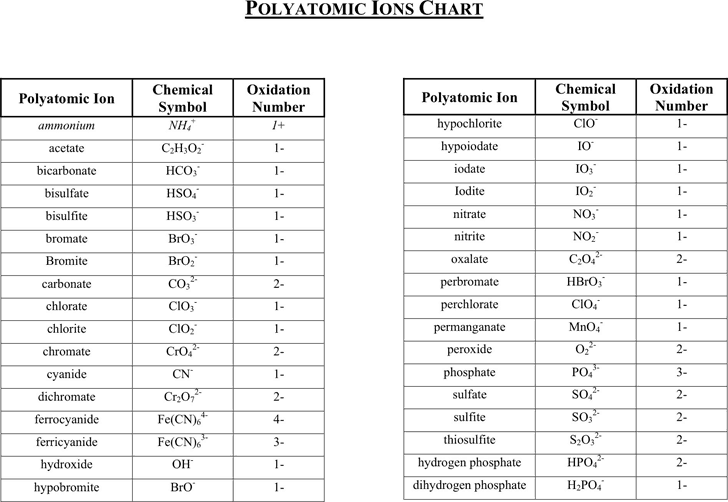

Common Polyatomic Ion Chart

Polyatomic Ion Chart Sample

Free Polyatomic Ion Chart

Related templates
For related tasks, see Electronegativity Charts and Comparison Guide.