
An army memorandum presents official information in an organized written format. The templates below include memorandum layouts and an army letter example. Select the document type appropriate to your task and the military organization receiving it.
View the templates and existing download links below.
Choosing the right format
These are reference starting points, not evidence that a document complies with current military instructions. Country, branch, unit and document purpose affect formatting. For U.S. Army use, consult the applicable edition of AR 25-50 and unit guidance.
Details to include
- Authorized letterhead or office identification, date and recipient
- Clear subject, purpose, references and numbered body paragraphs as required
- Signature block, point of contact, enclosures and distribution where applicable
How to use the template
- Confirm the correct memorandum or letter format with your unit.
- Replace all sample names, dates and office information.
- Check references, numbering and signature authority before routing for approval.
Worked example
For a training notification, state the event and date first, then identify who must attend and the required response. Keep background separate from the requested action.
For U.S. Army examples, see the official USAREUR-AF letterhead and correspondence resources; other organizations may use different standards.
Download and printing notes
Check the destination and file format of each existing download before using it. Some samples link to an external resource; its availability and terms are controlled by that provider.
What an Army memorandum is used for
The memorandum is the standard format for routine written communication within the U.S. Army. It is used to request action, pass on information, record decisions, document counseling and coordinate between offices. Because so many memos move through a unit every week, the Army sets out a consistent layout so readers can find the subject, the sender and the required action immediately.
The governing guidance for Army correspondence is Army Regulation 25-50, Preparing and Managing Correspondence, together with its associated pamphlet. These army memorandum templates follow that general structure, but you should always check the current version of the regulation and any local unit standards before finalizing a memo.
Common types of Army memorandums
- Memorandum for record (MFR): documents an event, decision or conversation for the file.
- Memorandum for a specific addressee: sends information or a request to an individual or office.
- Memorandum of instruction: explains procedures for an event, training or task.
- Memorandum of agreement or understanding: records terms agreed between organizations.
- Endorsement memorandums: forward a memo up or down the chain with comments.
- Request memorandums: ask for leave, training slots, equipment or exceptions to policy.
Army Memorandum Templates:
This printable army memorandum template provides a structured format that can be customized and printed for formal communication. It can be adapted with the appropriate office, unit, recipient, subject, date, and memorandum content.
The printable format is useful when a physical copy, signature, review, or filing record is required. Before printing an official document, verify that its formatting follows the requirements of the relevant organization.
Army Memorandum Format
This army memorandum format provides a useful framework for organizing official written communication. The layout can help users identify where important information should appear and how the memo can be structured for easy reading.
It can be customized for different administrative communication needs, but users should compare the final version with applicable military regulations or local instructions before using it as official correspondence.
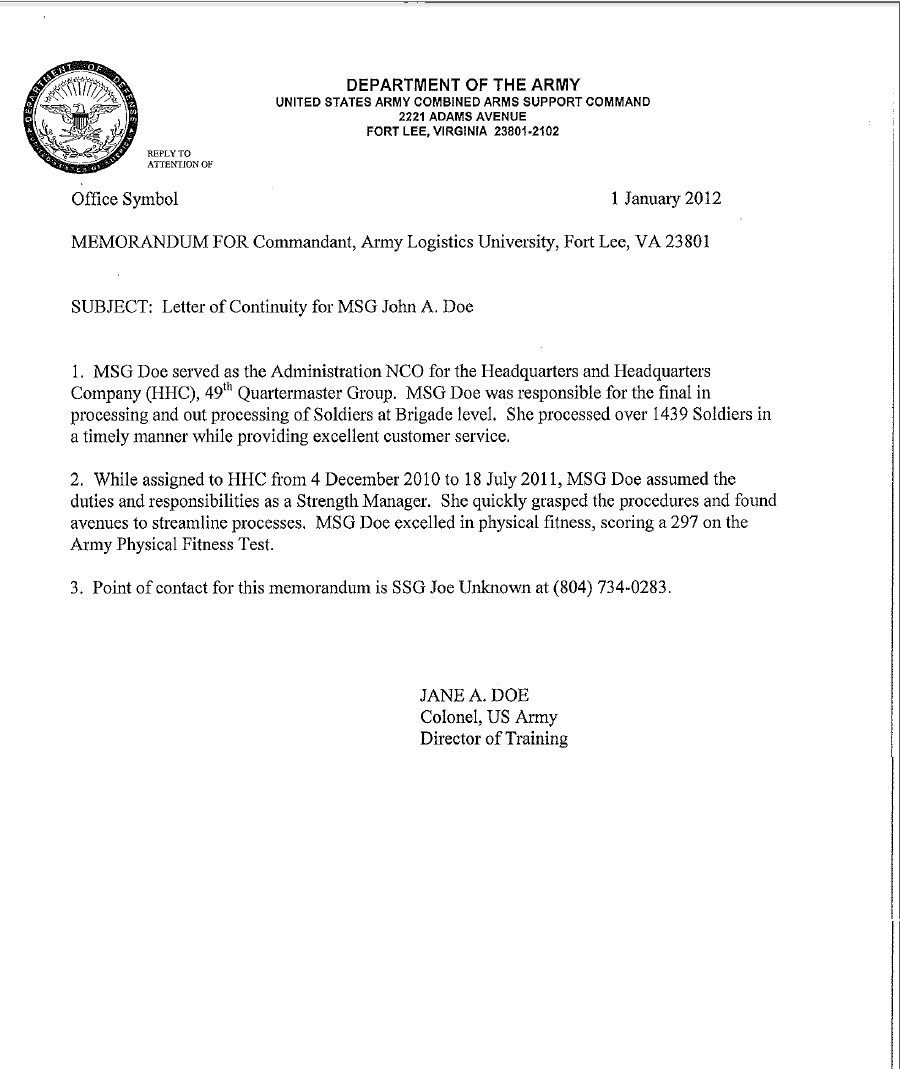

A consistent and readable format makes important information easier to review. Users can adapt the template to their particular communication purpose while ensuring that all required official elements are included.
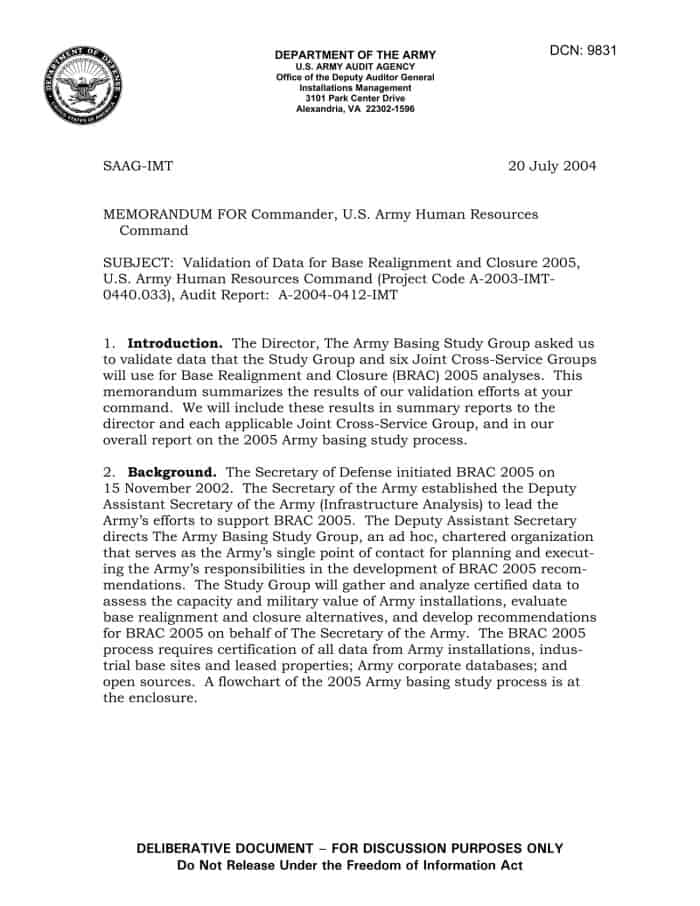
Army Letter
This army letter template provides an alternative format for formal military communication. It can be used as a starting point when the intended correspondence is better suited to a letter rather than a memorandum.
Customize the document with the appropriate sender, recipient, subject, message, and authorization information. As with any official military correspondence, check applicable formatting requirements before finalizing the document.
The basic layout, element by element
Letterhead
The organization’s name and address centered at the top of the first page.
Office symbol and date
The office symbol appears at the left margin and the date at the right margin on the same line. Military dates are written day, month and year, for example 30 October 2026.
MEMORANDUM FOR line
Names the recipient by office or title. For a memorandum for record, this line reads MEMORANDUM FOR RECORD.
FROM line
Used when the memo goes outside the originating headquarters or when needed for clarity.
SUBJECT line
A short description of the topic, no more than about ten words where possible.
Body
Numbered paragraphs. The first paragraph usually states the purpose; the final paragraph usually gives the point of contact.
Signature block
The signer’s name in capitals, rank and branch, and title, placed below the last paragraph.
Enclosures and distribution
Listed at the left margin below the signature block when they apply.
Writing an Army memo step by step
- Decide the purpose: inform, request, direct or record.
- Choose the right template type, such as an MFR or a memo for a named office.
- Fill in the letterhead, office symbol and date.
- Write a clear subject line that a reader can understand without opening the memo.
- Put the main point or request in paragraph 1. Army writing style favors the “bottom line up front” approach.
- Add supporting details in following paragraphs, using subparagraphs (a, b, c) only when needed.
- End with a point of contact, including name, phone and email.
- Add the signature block, enclosures and distribution, then proofread.
- Route the memo through the required approval chain before signature.
Army writing style tips
- Use short sentences and active voice.
- Keep most memos to one page.
- Avoid unnecessary acronyms, and spell each one out on first use.
- Use the same terms consistently, especially for dates, units and equipment.
- Read the memo aloud; if a sentence is hard to say, it is probably hard to read.
Common errors that get memos returned
- Wrong date format. Use day, full month and year, not 10/30/2026.
- Missing office symbol. Every memo should identify the originating office.
- Vague subject line. “Request” or “Information” tells the reader nothing.
- Burying the request. If the action is in paragraph 4, readers may miss it.
- Inconsistent margins or fonts. Templates help avoid formatting returns from administrative reviewers.
- No point of contact. Readers need to know whom to call with questions.
Worked example: a memorandum for record
After a range day, a platoon sergeant needs to document that a weapon malfunction was reported and handled. Using the MFR template, the office symbol and date “14 October 2026” go on the first line, and the memo is addressed MEMORANDUM FOR RECORD with the subject “Weapon Malfunction During Qualification Range”.
Paragraph 1 states the purpose: to document the malfunction and corrective action. Paragraph 2 gives the date, range, weapon serial number and what happened. Paragraph 3 describes the corrective action and who was notified. Paragraph 4 lists the platoon sergeant as point of contact. The signature block follows, and a copy of the range log is listed as an enclosure. The memo is filed with unit training records, alongside the attendance sheet for the range day.
Converting the format for civilian use
Many civilian organizations borrow parts of the Army format because it is efficient: a clear subject line, numbered paragraphs and a point of contact. If you need a business version, our general memo templates are a better fit. For formal requests to public offices, see the government letter formats, and for permission to act for someone else, use an authorization letter.
Army memorandum FAQs
Which regulation covers Army memorandum format?
Army Regulation 25-50 covers Army correspondence. Check the current edition and any command-specific guidance.
What font should I use?
Use the font your command and the current regulation specify. Templates provide a starting point, but local standards take precedence.
How long should a memorandum be?
Ideally one page. Use enclosures for detailed data rather than lengthening the memo, and reference each enclosure in the body so readers know when to consult it.
Can I sign a memo digitally?
Many units use digital signatures through approved systems. Follow your organization’s policy and keep a signed copy on file.
What is the difference between an MFR and a regular memo?
An MFR records information for the file and is not addressed to a specific recipient. A regular memo is addressed to a person or office and usually asks for action or provides information.
Do civilians working for the Army use this format?
Yes, Department of the Army civilians generally prepare correspondence in the same format.
Summary
An Army memorandum is short, structured and direct. Use the correct header elements, put the main point first, number your paragraphs and close with a point of contact. Download the army memorandum templates above as a starting point and confirm details against current guidance. More document formats are available in the templates category.
Related templates
For related tasks, see Memo Templates and Business Memorandum Example and Government Letter Formats: Requests and Complaints.