
A proposal email should make the proposed work and the requested next step easy to understand. These 20 samples cover requested services, pilot projects, partnerships, scope changes and follow-ups. Each includes a subject line and a complete email with placeholders for the real deliverables, schedule and fee. The samples are also available in two editable Word packs, with ten messages in each download.
How to choose and personalize the email
Start with the need the proposal addresses, then identify the work you are offering. Use specific deliverables rather than broad claims about helping a business grow. State the proposed timing and fee only when they are supported by the scope. If an attachment contains the detail, refer to the correct file and make sure it is actually attached. The email should introduce the proposal without contradicting its assumptions or exclusions.
Distinguish an initial idea from a quote ready for approval. A partnership introduction can invite a conversation; a revised proposal should explain what changed; a scope-change email should identify the additional work before it begins. Do not use an approval sentence that assumes silence means agreement. Give the recipient a clear way to ask questions and use the actual approval process agreed for the work.
For follow-ups, identify the earlier proposal and ask a practical question about timing or review. Avoid invented urgency or repeated messages with no new information. When the client’s priorities change, revise the scope before sending a new price. Keep the proposal reference, version and attachment consistent so both parties can tell which document is being discussed. A concise message with a clear action is more useful than an enthusiastic summary that leaves the work undefined.
Twenty sample emails for different situations
Each example contains a subject line, greeting, message and sign-off. Keep only the details that fit your circumstances. Bracketed names, dates, amounts and links are prompts to replace, not facts about your situation. Read the whole message after editing so the subject and body still match.
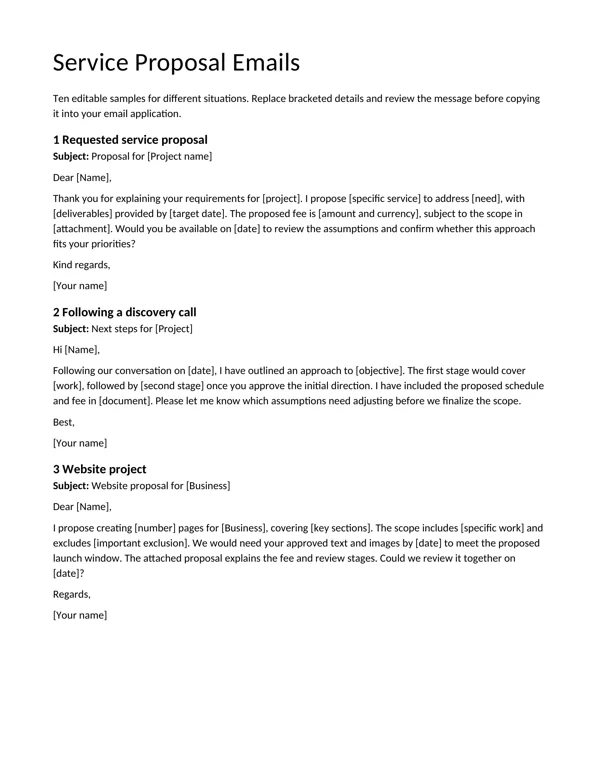
1. Requested service proposal
Subject: Proposal for [Project name]
Dear [Name],
Thank you for explaining your requirements for [project]. I propose [specific service] to address [need], with [deliverables] provided by [target date]. The proposed fee is [amount and currency], subject to the scope in [attachment]. Would you be available on [date] to review the assumptions and confirm whether this approach fits your priorities?
Kind regards,
[Your name]
2. Following a discovery call
Subject: Next steps for [Project]
Hi [Name],
Following our conversation on [date], I have outlined an approach to [objective]. The first stage would cover [work], followed by [second stage] once you approve the initial direction. I have included the proposed schedule and fee in [document]. Please let me know which assumptions need adjusting before we finalize the scope.
Best,
[Your name]
3. Website project
Subject: Website proposal for [Business]
Dear [Name],
I propose creating [number] pages for [Business], covering [key sections]. The scope includes [specific work] and excludes [important exclusion]. We would need your approved text and images by [date] to meet the proposed launch window. The attached proposal explains the fee and review stages. Could we review it together on [date]?
Regards,
[Your name]
Download both options and view the previews
Service Proposal Emails
This pack contains ten of the samples shown in the article. The preview shows its opening page; the Word download contains the complete set. Save the download, keep an original copy and edit a separate version for your project. Review the finished wording and layout before use.
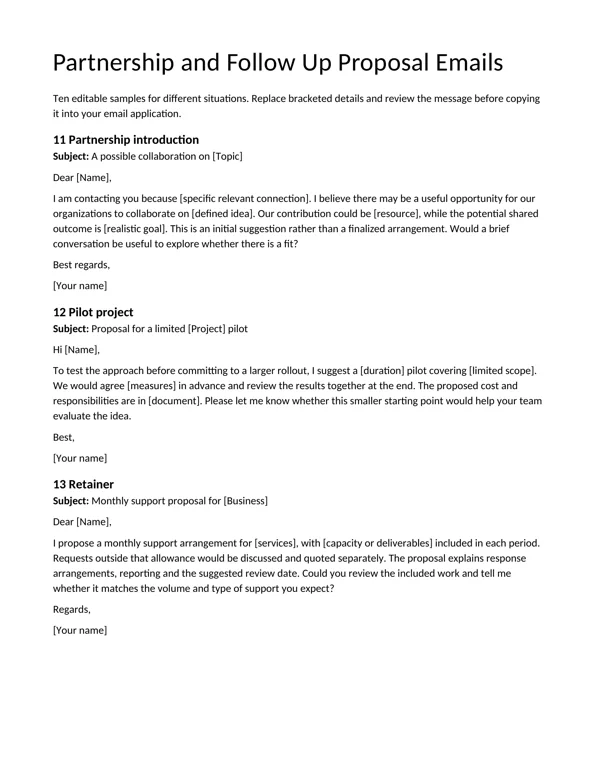
Partnership and Follow Up Proposal Emails
This pack contains ten of the samples shown in the article. The preview shows its opening page; the Word download contains the complete set. Save the download, keep an original copy and edit a separate version for your project. Review the finished wording and layout before use.
More email examples
4. Design assignment
Subject: Design proposal for [Campaign]
Hi [Name],
Based on your brief, I suggest developing [design deliverables] for [campaign]. The work would include [number] initial concepts and [number] agreed revision rounds. I have set out the file formats, schedule and proposed fee in [attachment]. Please confirm whether the listed outputs cover your intended print and digital uses before we proceed.
Best,
[Your name]
5. Consulting engagement
Subject: Proposed support for [Business issue]
Dear [Name],
I propose a short consulting engagement focused on [defined issue]. We would begin with [discovery activity], review [information] and deliver [recommendation or plan]. The engagement would not include implementation unless separately agreed. The attached scope explains the proposed hours and fee. Would a discussion in [period] help you assess whether the work is appropriate?
Kind regards,
[Your name]
6. Training workshop
Subject: Workshop proposal for [Team]
Dear [Name],
I would like to propose a [duration] workshop on [topic] for [audience]. Participants would work through [activities] and leave with [practical output]. The proposed session assumes [group size] and [delivery format]. I have included the preparation requirements, fee and available dates in [document]. Please share any access or scheduling requirements before we confirm arrangements.
Best wishes,
[Your name]
7. Photography service
Subject: Photography proposal for [Event]
Hi [Name],
Thank you for your inquiry about [event] on [date]. I propose [hours] of coverage, including [deliverables] with delivery by [timeframe]. The quote assumes [location and scope]; travel or additional coverage would be agreed separately. Please review [attachment] and let me know whether you would like to discuss the package before confirming a booking.
Best,
[Your name]
8. Maintenance service
Subject: Maintenance proposal for [Location]
Dear [Name],
We propose providing [maintenance tasks] at [location] on a [frequency] schedule. The scope lists the included inspections, reporting and exclusions so your team can compare it with your requirements. The proposed fee is [amount] per [period]. Could we arrange a site review on [date] to confirm access and any conditions affecting the work?
Regards,
[Your name]
9. Research assignment
Subject: Research proposal for [Question]
Dear [Name],
I propose a research assignment to examine [specific question] for [decision]. The work would use [agreed sources or method] and deliver [report or dataset] by [date]. The scope explains the limits of the research and the proposed fee. Please review the question and expected output so we can confirm that the findings will serve your intended use.
Kind regards,
[Your name]
10. Product supply
Subject: Supply proposal for [Items]
Dear [Name],
In response to your request, we propose supplying [items and quantities] according to [specification]. The quote lists unit prices, the estimated delivery window and the proposed payment terms. Availability will be confirmed when the order is accepted. Please review the specification and delivery address, and let us know whether you require any changes before issuing an order.
Regards,
[Your name]
11. Partnership introduction
Subject: A possible collaboration on [Topic]
Dear [Name],
I am contacting you because [specific relevant connection]. I believe there may be a useful opportunity for our organizations to collaborate on [defined idea]. Our contribution could be [resource], while the potential shared outcome is [realistic goal]. This is an initial suggestion rather than a finalized arrangement. Would a brief conversation be useful to explore whether there is a fit?
Best regards,
[Your name]
12. Pilot project
Subject: Proposal for a limited [Project] pilot
Hi [Name],
To test the approach before committing to a larger rollout, I suggest a [duration] pilot covering [limited scope]. We would agree [measures] in advance and review the results together at the end. The proposed cost and responsibilities are in [document]. Please let me know whether this smaller starting point would help your team evaluate the idea.
Best,
[Your name]
13. Retainer
Subject: Monthly support proposal for [Business]
Dear [Name],
I propose a monthly support arrangement for [services], with [capacity or deliverables] included in each period. Requests outside that allowance would be discussed and quoted separately. The proposal explains response arrangements, reporting and the suggested review date. Could you review the included work and tell me whether it matches the volume and type of support you expect?
Regards,
[Your name]
14. Renewal
Subject: Proposed renewal of [Service]
Dear [Name],
Our current arrangement for [service] ends on [date]. I have attached a renewal proposal covering [scope] for [period], including [specific change or unchanged provision]. Please review the proposed fee and service details before deciding whether to renew. I would be happy to discuss your priorities and any adjustments needed for the next period.
Kind regards,
[Your name]
15. Scope change
Subject: Proposed change to [Project] scope
Hi [Name],
Your request to add [new work] would change the agreed scope for [project]. I propose including it with an additional [fee or time allowance], moving the target date to [date] if approved. The original work remains described in [reference]. Please confirm whether you would like to approve this change or discuss another option before the additional work begins.
Best,
[Your name]
16. Revised budget
Subject: Revised proposal within [Budget]
Dear [Name],
Thank you for explaining the available budget. I have revised the proposal to prioritize [essential work] and remove [deferred work]. The updated fee is [amount], with the deliverables and assumptions listed in [attachment]. Please review the changes carefully so we can confirm that the reduced scope still addresses your immediate need.
Regards,
[Your name]
17. Follow-up
Subject: Follow-up on the [Project] proposal
Hi [Name],
I am following up on the proposal sent on [date] for [project]. Have you had a chance to review the scope and suggested schedule? If the timing or priorities have changed, I would appreciate an update so I can plan accordingly. I am happy to answer questions or arrange a short discussion if that would be useful.
Best,
[Your name]
18. Clarification
Subject: Clarification on [Proposal item]
Dear [Name],
Thank you for your question about [item]. The proposed scope includes [specific inclusion] and does not include [specific exclusion]. I have updated [section] to make that distinction clearer. Please let me know whether the revised wording matches your understanding before we move toward approval. The other assumptions remain as stated in the proposal.
Kind regards,
[Your name]
19. Approval request
Subject: Request to approve the [Project] proposal
Dear [Name],
We have incorporated the changes discussed on [date] into the proposal for [project]. Please review the final scope, fee and schedule in [document]. If these reflect your understanding, please confirm through [agreed approval process] by [date]. We will arrange the start once the required approval and any agreed prerequisites are complete.
Regards,
[Your name]
20. Paused opportunity
Subject: Checking the timing of [Project]
Hi [Name],
When we last spoke, [project] was on hold while your team reviewed [priority]. I am checking whether it would be useful to revisit the proposal now or at a later date. The earlier schedule and pricing would need to be reconfirmed before proceeding. Please let me know your preferred timing, including if the opportunity is no longer being considered.
Best,
[Your name]
Copying the finished draft into an email
Use the Word download as an editing copy, then paste the finished message into your email application. Check paragraph breaks, the subject field, the recipient and any attachments. A document can contain several examples, so make sure only the intended message is copied. Preview the email before sending, and remove every bracketed prompt. The download does not send messages, schedule delivery or connect to your contacts.
The email that carries your proposal
A proposal can be excellent and still go unread if the email that delivers it is vague, long or easy to ignore. The proposal email is often the first thing a decision maker sees: it reminds them who you are, summarizes what you are offering, points to the attached or linked proposal and asks for a clear next step. Follow-up emails then keep the conversation alive without becoming pushy. These proposal email templates provide 20 samples with subject lines for services and follow-ups, in two editable Word packs that you can copy and personalize.
The samples suit freelancers, consultants, agencies, contractors, trainers, suppliers and small businesses sending quotes or service proposals to new and existing clients.
Types of proposal emails covered
Initial proposal email
Sent after a discovery call or request, attaching or linking the proposal and summarizing the key points.
Cold service proposal
A shorter email introducing a specific service to a prospect you have researched, usually inviting a conversation before sending a full proposal.
Proposal for an existing client
Suggests additional work, a renewal or an upgraded package, building on results already delivered.
Revised proposal email
Sends an updated version after feedback, highlighting what changed.
Follow-up emails
Polite reminders sent days or weeks after the proposal, offering help or answering likely questions.
Closing the loop
A final message that leaves the door open if the client decides not to proceed now.
Anatomy of an effective proposal email
Subject line
Specific and recognizable, for example “Proposal: Website Redesign for [Company]” or “Follow-up on Bookkeeping Proposal”.
Personal opening
Reference the conversation, request or shared context in one sentence.
Summary of value
Two or three lines on the problem you will solve and the outcome the client can expect.
Key details
Scope headline, timeline and price or price range, so busy readers grasp the essentials.
Attachment or link
Clearly named file or link, such as “[Company]_Proposal_Nov2026.pdf”.
Clear call to action
Ask for one next step: a short call, approval, or feedback by a date.
Signature
Name, role, company and contact details.
How to write a proposal email step by step
- Confirm the decision maker and anyone who should be copied.
- Choose the right sample for the situation: new prospect, existing client, revision or follow-up.
- Write a specific subject line with the client’s name and the service.
- Open with context, such as “Thank you for your time on Tuesday.”
- Summarize the offer in plain language, focusing on the client’s goals.
- State scope, timing and price briefly; detail stays in the proposal.
- Attach or link the proposal and check that it opens.
- Ask for a specific next step with a suggested time.
- Proofread names, figures and dates.
- Schedule a follow-up reminder in your calendar.
When and how often to follow up
A first follow-up a few business days after sending is common, followed by another a week or so later if there is no response. Each follow-up should add value: answer a likely question, share a relevant example, or offer a quick call. After two or three follow-ups, a polite closing message is usually appropriate. Adjust timing to the client’s stated decision date.
Tips for proposal emails that get replies
- Keep the email short; the proposal holds the detail.
- Use the client’s own words about their goals.
- Mention a deadline or start date when relevant, without false urgency.
- Offer two time options for a call.
- Send from a professional address with a clear email signature.
- Name attachments clearly and keep file sizes small.
- Track sent proposals and follow-up dates in a simple list.
Common mistakes to avoid
- Generic subject lines such as “Proposal” or “Following up”.
- Long emails repeating the entire proposal.
- No call to action, leaving the client unsure what to do next.
- Wrong names or company details copied from another proposal.
- Aggressive follow-ups that pressure rather than help.
- Missing attachments. Always check before sending.
Worked example: an IT support proposal
A small IT consultancy meets the operations manager of a growing accounting firm that needs managed IT support. After the call, the consultant sends an email titled “Proposal: Managed IT Support for Lane & Co”. It thanks the manager for the meeting, summarizes the firm’s main concerns of slow onboarding of new staff and inconsistent backups, and outlines the proposed monthly support plan, onboarding process and start date. The full proposal is attached as a PDF, alongside a short company profile and two trade references.
The email ends by suggesting a 20-minute call on Thursday or Friday to answer questions. Four business days later, with no reply, the consultant sends a follow-up sharing a one-page project outline for the first month. The manager replies asking for a comparison of two support tiers, which the consultant sends using a product comparison table. The firm accepts the higher tier the following week.
Personalization beyond the name
Real personalization goes further than inserting a first name. Mention a detail from your conversation, a recent company announcement or a specific challenge the client raised. Reflect their priorities, such as cost control, speed or quality, in how you summarize the offer. Personalized proposals show you listened, which is often the deciding factor between similar offers.
Pricing language in emails
Clients often scan proposal emails for price first. Present fees clearly and consistently with the proposal, for example “a fixed fee of X” or “a monthly retainer of X, billed in advance”. If pricing depends on choices, give a range and explain what affects it. Avoid surprising clients with costs that appear only in the attachment, and state whether taxes are included.
Keeping track of proposals
A simple tracking sheet helps you follow up consistently: client, service, date sent, value, next follow-up date and status. Reviewing it weekly shows which proposals need attention and which kinds of work you win most often. Over time, you will learn which subject lines, formats and follow-up timings work best for your clients.
Proposal emails for different audiences
Tailor tone and detail to the reader. A founder of a small business may welcome a friendly, conversational note and a quick phone call. A procurement team in a large organization may need formal language, references to their tender number and documents in a specific format. Public sector buyers may require proposals to be submitted through a portal, with the email serving only as a notification. Check the client’s instructions carefully and mirror their language where possible.
Writing subject lines that get opened
The subject line decides whether your email is opened today or buried. Good proposal subject lines are specific, short and easy to search for later. Include the service and the client’s name, such as “Proposal: Office Cleaning for Greenway Dental”, or reference a shared event, such as “Following our call on Tuesday – training proposal”. For follow-ups, keep the original subject so the thread stays together, or add a helpful cue such as “Quick question on timeline”.
Avoid subject lines that look like marketing, use all capitals or rely on urgency words. Clients receive many emails, and clear, professional wording stands out more than clever phrasing. If you send several proposals, a consistent pattern also makes your own records easier to search.
Handling questions and objections by email
Clients often reply with questions about price, timing or scope. Answer promptly, directly and in the same thread. If a question reveals a misunderstanding, clarify it and, where needed, send a revised proposal rather than explaining changes only in an email. If the client is concerned about cost, consider offering a smaller first phase rather than simply discounting. Summarize any agreed changes at the end of the conversation so both sides share the same understanding before work begins.
Proposal email template FAQs
Should I attach the proposal or link to it?
Either works. Attachments are familiar; links allow tracking and updates. Follow the client’s preference if known.
How long should a proposal email be?
Usually a short email of a few paragraphs, with details in the proposal.
How soon should I follow up?
A few business days after sending is common, adjusted to the client’s decision timeline.
What if the client says no?
Thank them, ask if they are open to feedback, and offer to stay in touch for future needs.
Can I use these templates for tenders?
They can help with cover emails, but always follow the tender’s submission rules.
Should I include prices in the email?
A headline price or range helps busy readers; full details belong in the proposal.
Conclusion
A clear proposal email gives your offer the best chance of being read, understood and accepted. Use one of the 20 samples to write a specific subject line, summarize value, attach the proposal and ask for a clear next step, then follow up politely. Download the two Word packs below and browse more business templates in the category archive. Treat every email as part of the service you are offering, because clients often judge how you will work from how you communicate.
Related resources
For the work around this template, you may also find Free Company Profile Templates and PDF Examples, Blank Purchase Order Forms and Completion Guide, Memo Templates and Business Memorandum Example useful. Choose the resource that matches the next step and keep names, contact details and project information consistent between documents.
Frequently asked questions
Is the email a complete project agreement?
The samples introduce or discuss a proposal. They do not replace a complete scope, agreed terms or the approval process required for the work.
Should I include a price in the email?
Include a price when the basis is clear and matches the detailed proposal. Otherwise explain what information is needed before a quote can be confirmed.
How do I follow up without sounding pushy?
Refer to the proposal and ask whether the timing or priorities have changed. Give the recipient a useful way to respond rather than repeating a demand for approval.