
A resignation email should communicate the decision clearly, identify the role and make the proposed departure arrangements easy to discuss. These 20 samples cover standard notice, personal circumstances, remote work, requests for an earlier release and handover follow-ups. Each includes a subject line and complete wording. Two editable Word packs contain ten samples each. Replace the date and other details after checking the notice arrangements that apply to your own role.
How to choose and personalize the email
Put the decision near the beginning and identify the job. Use a clear proposed final working date, or request a discussion when the date has not been agreed. Do not assume that a sample notice period applies to your situation. The templates deliberately use placeholders rather than declaring a universal number of days. Keep any request to shorten notice distinct from a statement that the employer has already approved the change.
Include only the personal explanation you are comfortable sharing. A short reference to personal reasons can be enough for the message itself. Health or family details do not need to be expanded merely to fill a template. Keep the email professional and factual. If you need to raise a separate concern, decide how that should be handled rather than mixing a long account of unrelated issues into the notice.
Make the practical transition understandable. Offer a handover that reflects what you can actually do, and ask who should receive the information. Do not include passwords in the email or promise availability after departure without an agreed arrangement. Once the final date is confirmed, keep a copy of that confirmation and align the handover message with it. Read the recipient list carefully so the notice reaches the intended manager or designated process.
Twenty sample emails for different situations
Each example contains a subject line, greeting, message and sign-off. Keep only the details that fit your circumstances. Bracketed names, dates, amounts and links are prompts to replace, not facts about your situation. Read the whole message after editing so the subject and body still match.
1. Standard notice
Subject: Resignation notice from [Your name]
Dear [Manager],
Please accept this email as notice of my resignation from my role as [Job title] at [Company]. Based on my agreed notice arrangements, I propose [date] as my final working day. Thank you for the opportunities I have had here. I will prepare a handover of my current work and discuss the transition with you.
Kind regards,
[Your name]
2. Brief formal notice
Subject: Notice of resignation
Dear [Manager],
I am writing to resign from my position as [Job title]. My proposed final working day is [date], in line with the notice arrangements I understand to apply. Please confirm the date and any required next steps. I will continue to carry out my responsibilities and organize a clear handover during the remaining period.
Regards,
[Your name]
Download both options and view the previews
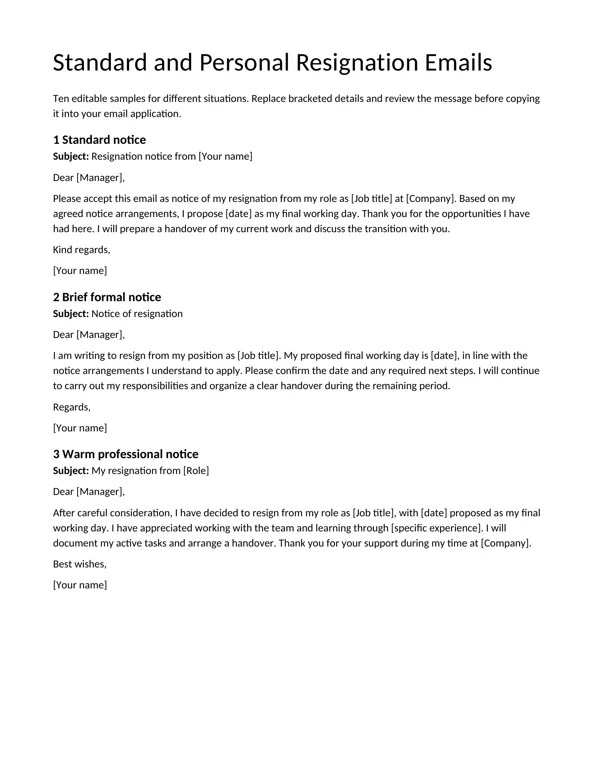
Standard and Personal Resignation Emails
This pack contains ten of the samples shown in the article. The preview shows its opening page; the Word download contains the complete set. Save the download, keep an original copy and edit a separate version for your project. Review the finished wording and layout before use.
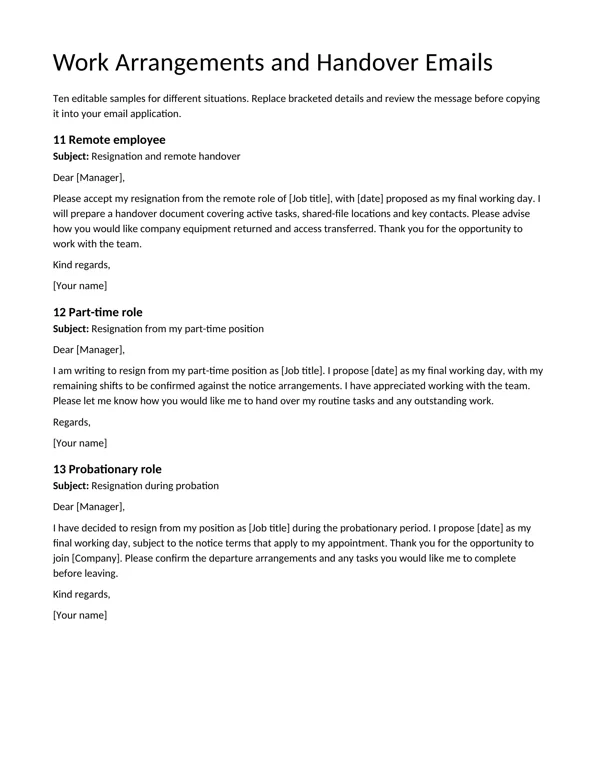
Work Arrangements and Handover Emails
This pack contains ten of the samples shown in the article. The preview shows its opening page; the Word download contains the complete set. Save the download, keep an original copy and edit a separate version for your project. Review the finished wording and layout before use.
More email examples
3. Warm professional notice
Subject: My resignation from [Role]
Dear [Manager],
After careful consideration, I have decided to resign from my role as [Job title], with [date] proposed as my final working day. I have appreciated working with the team and learning through [specific experience]. I will document my active tasks and arrange a handover. Thank you for your support during my time at [Company].
Best wishes,
[Your name]
4. New opportunity
Subject: Resignation and proposed transition
Dear [Manager],
I have decided to accept another opportunity and am resigning from my position as [Job title]. My proposed last working day is [date], subject to confirmation of the applicable notice arrangements. I am grateful for the experience gained at [Company]. I will help organize the handover of my current responsibilities before I leave.
Kind regards,
[Your name]
5. Career change
Subject: Resignation from [Job title]
Dear [Manager],
I am resigning from my role as [Job title] to pursue a different career direction. I propose [date] as my final working day and would appreciate confirmation of the transition arrangements. Thank you for the experience and encouragement I have received here. I will prepare a summary of ongoing work and outstanding actions for the handover.
Regards,
[Your name]
6. Further study
Subject: Notice of resignation to pursue study
Dear [Manager],
I am writing to resign from my position as [Job title] because I have decided to continue my studies. My proposed final working day is [date], in accordance with the arrangements to be confirmed. I have valued my time with [Company]. I will organize my files and current tasks to support an orderly handover.
Best wishes,
[Your name]
7. Relocation
Subject: Resignation following relocation plans
Dear [Manager],
Due to my planned relocation, I have decided to resign from my role as [Job title]. I propose [date] as my final working day and would welcome a discussion about the handover schedule. Thank you for the opportunities I have had at [Company]. I will provide a clear record of my current responsibilities before leaving.
Kind regards,
[Your name]
8. Personal reasons
Subject: Resignation for personal reasons
Dear [Manager],
Please accept this email as notice of my resignation from [Job title] for personal reasons. My proposed final working day is [date]. I would prefer to keep the personal details private, but I am available to discuss the practical transition. Thank you for your understanding. I will prepare a handover of my outstanding work.
Regards,
[Your name]
9. Family commitments
Subject: Notice of resignation from [Role]
Dear [Manager],
I have decided to resign from my role as [Job title] to focus on family commitments. I propose [date] as my final working day, subject to confirmation of the notice arrangements. I appreciate the experience I have gained here and your understanding of my decision. I will work with you to organize an appropriate handover.
Kind regards,
[Your name]
10. Health privacy
Subject: Resignation and transition arrangements
Dear [Manager],
I am resigning from my position as [Job title] for personal health reasons. I propose [date] as my final working day and would like to discuss the practical arrangements privately. I do not wish to include medical details in this email. Thank you for your understanding; I will provide the handover information I am able to prepare.
Regards,
[Your name]
11. Remote employee
Subject: Resignation and remote handover
Dear [Manager],
Please accept my resignation from the remote role of [Job title], with [date] proposed as my final working day. I will prepare a handover document covering active tasks, shared-file locations and key contacts. Please advise how you would like company equipment returned and access transferred. Thank you for the opportunity to work with the team.
Kind regards,
[Your name]
12. Part-time role
Subject: Resignation from my part-time position
Dear [Manager],
I am writing to resign from my part-time position as [Job title]. I propose [date] as my final working day, with my remaining shifts to be confirmed against the notice arrangements. I have appreciated working with the team. Please let me know how you would like me to hand over my routine tasks and any outstanding work.
Regards,
[Your name]
13. Probationary role
Subject: Resignation during probation
Dear [Manager],
I have decided to resign from my position as [Job title] during the probationary period. I propose [date] as my final working day, subject to the notice terms that apply to my appointment. Thank you for the opportunity to join [Company]. Please confirm the departure arrangements and any tasks you would like me to complete before leaving.
Kind regards,
[Your name]
14. Fixed-term early departure request
Subject: Request to discuss resignation from [Role]
Dear [Manager],
I would like to resign from my fixed-term role as [Job title] and request a discussion about whether [date] can be agreed as my final working day. I understand that the contract and departure arrangements need to be reviewed. Please let me know a suitable time to discuss the request and the practical handover.
Regards,
[Your name]
15. Request shorter notice
Subject: Request for an earlier release date
Dear [Manager],
I am resigning from my role as [Job title] and would like to request [date] as an earlier final working day. I understand that this requires discussion and agreement rather than assumption. I can prepare [specific handover work] to support the transition. Please let me know whether we can review the request and confirm an appropriate arrangement.
Kind regards,
[Your name]
16. Urgent circumstances
Subject: Resignation and urgent discussion request
Dear [Manager],
Due to urgent personal circumstances, I am resigning from my position as [Job title] and need to discuss my availability and final working date as soon as possible. Please contact me at [contact] when convenient today. I recognize that the departure arrangements require clarification and will share the practical information I can to assist with the transition.
Regards,
[Your name]
17. Manager resignation
Subject: Resignation and team transition
Dear [Recipient],
I am resigning from my position as [Management role], with [date] proposed as my final working day. I will prepare a transition summary covering team responsibilities, current decisions and upcoming commitments. Please advise who should receive each part of the handover. I appreciate the opportunity to have worked with the team and will coordinate the remaining work with you.
Kind regards,
[Your name]
18. Positive exit with limited detail
Subject: Formal notice of my departure
Dear [Manager],
Please accept my resignation from [Job title]. My proposed final working day is [date], subject to confirmation of the applicable arrangements. I have decided that this is the right time for a change and would prefer to keep the reasons brief. Thank you for the experience gained here. I will organize the handover of my current work.
Regards,
[Your name]
19. After a conversation
Subject: Written confirmation of my resignation
Dear [Manager],
Following our conversation on [date], I am confirming my resignation from [Job title]. We discussed [date] as the proposed final working day; please confirm the agreed date in writing. I will prepare the handover items we identified, including [items]. Thank you for discussing the transition with me and clarifying the next steps.
Kind regards,
[Your name]
20. Handover follow-up
Subject: Handover update before my departure
Dear [Manager],
Following my resignation notice dated [date], I have prepared the handover summary at [location]. It covers active tasks, upcoming deadlines and the contacts involved. My final working day remains [confirmed date]. Please let me know if you would like any part clarified before then, and confirm who will take ownership of the remaining items.
Best regards,
[Your name]
Copying the finished draft into an email
Use the Word download as an editing copy, then paste the finished message into your email application. Check paragraph breaks, the subject field, the recipient and any attachments. A document can contain several examples, so make sure only the intended message is copied. Preview the email before sending, and remove every bracketed prompt. The download does not send messages, schedule delivery or connect to your contacts.
Why the resignation email matters
Leaving a job is a normal part of a career, but the way you resign stays in people’s memories. A clear, courteous resignation email confirms your decision in writing, states your last working day, offers help with the handover and leaves the door open for references and future opportunities. These resignation email templates bring together 20 samples with subject lines, covering different notice periods, reasons and relationships, and the two editable Word packs let you copy a sample and personalize it in minutes.
Many people now resign by email, either because they work remotely or because their employer asks for written confirmation after a conversation. Even when you tell your manager in person first, a follow-up email creates a record of the date you gave notice, which matters for calculating your final day and pay.
What a resignation email should include
Clear subject line
Something simple such as “Resignation – [Your Name]” or “Notice of Resignation – [Your Name], [Role]” so it is easy to find later.
Statement of resignation
One sentence stating that you are resigning from your position, with your job title.
Notice period and last working day
Your final date, calculated according to your contract or company policy.
Thanks
A brief note of appreciation for the opportunity, colleagues or experience.
Handover offer
A commitment to help with the transition, such as documenting tasks or training a replacement.
Practical questions
Optional: returning equipment, final pay, unused leave or exit interview arrangements.
Professional sign-off
Your name and contact details, and, if appropriate, a personal email for staying in touch.
How to choose and personalize a sample step by step
- Check your contract. Confirm your required notice period and how notice must be given.
- Talk first if you can. A conversation with your manager before sending the email is usually appreciated.
- Pick a sample that matches your situation: standard notice, short notice, remote role, new opportunity, relocation, further study, health or family reasons.
- Write a clear subject line using your name.
- State your last day precisely, for example “My last working day will be Friday, 27 November.”
- Keep reasons brief. You do not have to explain why you are leaving; if you do, keep it positive or neutral.
- Offer handover help with specific examples relevant to your role.
- Address the right people. Send to your manager and copy HR if company policy requires it.
- Proofread names, dates and tone before sending.
- Keep a copy of the sent email and any reply.
When to use each type of resignation email
Standard notice
For most situations where you are giving the full contractual notice period.
Short notice
When you need to leave sooner, with an acknowledgement and an offer to discuss options.
Remote or hybrid roles
Including arrangements for returning laptops and access cards.
New opportunity
Mentions moving to a new role without unnecessary detail.
Personal reasons
For health, family, relocation or study, kept brief and respectful of your privacy.
Retirement
A warmer, reflective tone that may thank colleagues over many years.
Tips for a professional resignation
- Keep the email short, ideally a few short paragraphs.
- Remain positive or neutral, even if you are leaving because of problems.
- Avoid criticism of colleagues or management in writing.
- Be specific about your last day and handover.
- Send during working hours rather than late at night.
- Prepare a handover document before your final week.
- Update your personal contact details if you want to stay in touch.
Common mistakes to avoid
- Resigning by email without any prior conversation, when a quick call or meeting is possible.
- Unclear last day, which creates confusion about notice and pay.
- Over-explaining reasons or venting frustrations.
- Typos in names or dates.
- Forgetting company property and access arrangements.
- Copying the whole team before your manager has had a chance to announce your departure.
Worked example: leaving for a new role with four weeks’ notice
Sana is a marketing coordinator moving to a new company. Her contract requires four weeks’ notice. She meets her manager on Monday morning, then sends an email with the subject “Resignation – Sana Malik, Marketing Coordinator”. It states that she is resigning, that her last working day will be Friday, 27 November, thanks the team for the support she received, and offers to document her campaign workflows and train whoever covers her responsibilities.
In the following weeks, she prepares a handover note, shares project status using the team’s usual format, returns her employee ID card and laptop on her final day, and asks HR to confirm her final pay and unused leave. A short internal memo from her manager announces her departure and the interim cover. Before leaving, she updates her personal email signature and contact details for colleagues who want to stay in touch.
Handover essentials
A good handover protects your reputation and helps colleagues. List your ongoing projects, deadlines, key contacts, passwords handled through approved systems, recurring tasks and where files are stored. Arrange short meetings with whoever will take over each area. If your employer asks for a no objection certificate or other paperwork for your next role, request it early in your notice period so it is ready in time.
After you resign
Your manager may want to discuss counteroffers, exit interviews or an earlier finish date. Stay professional in these conversations and confirm any agreed changes in writing. Ask whether a reference will be provided and who will give it. Keep copies of payslips and your employment letter. If you are moving into a new job search instead of a confirmed role, update your bio-data or CV while your recent achievements are fresh.
Resignation emails in different workplaces
Expectations differ across organizations. In small businesses, the owner may prefer a personal conversation followed by a short email. In large companies, HR may require resignation through a formal system as well as an email. Public sector and unionized workplaces may have specific procedures. Whatever the setting, the core of the email stays the same: clear notice, a precise last day, thanks and a handover offer.
Tone and wording tips
Resignation emails are read carefully, sometimes more than once, so wording matters. Use plain, warm language rather than stiff legal phrases. Replace vague lines such as “in the near future” with exact dates. If you have had a difficult experience, it is usually wiser to raise concerns through an exit interview or formal channel than in the resignation email itself, which may be kept on your file. Read the email aloud before sending to check that it sounds like you and that the tone is respectful.
Using the Word packs efficiently
The two editable Word packs make it easy to compare samples side by side. Open the pack, scan the subject lines to find two or three that match your situation, and copy the closest one into a new email. Replace every placeholder, including names, job titles and dates, and delete any sentences that do not apply. Save your final version in a personal folder so you have a record of exactly what you sent.
Saying goodbye to colleagues
Once your manager has announced your departure, you may want to send a separate farewell message to colleagues, usually on or near your last day. This is different from the resignation email: it is warmer and more personal, thanks people for working with you and shares how to stay in touch. Keep it short, avoid discussing your reasons for leaving, and send it to the groups you actually worked with rather than the whole company unless that is normal in your workplace. A thoughtful farewell leaves a lasting good impression and makes it easier to reconnect professionally in the future.
A final checklist before sending
Check the recipient, subject line, job title, last working day and spelling of every name. Confirm you have attached nothing by mistake, and that your tone would read well if the email were forwarded to HR or a future referee.
Resignation email FAQs
Is it acceptable to resign by email?
Yes, in many workplaces, especially remote ones. If possible, speak with your manager first and then send the email as written confirmation.
Do I have to give a reason for resigning?
Usually not. You can keep the reason brief or leave it out entirely.
How much notice should I give?
Follow your contract or company policy. If unsure, check with HR.
Who should receive my resignation email?
Your direct manager, and HR if your company requires it.
Can I withdraw a resignation after sending it?
Only if your employer agrees. Think carefully before sending.
Should I mention my new employer?
It is optional. Many people simply say they have accepted a new opportunity.
Conclusion
A well-written resignation email helps you leave on good terms, protects your references and makes the transition smoother for everyone. Choose one of the 20 samples, add a clear subject line and last working day, offer a practical handover and keep the tone positive. Download the two Word packs below and explore more workplace documents in the category archive.
Related resources
For the work around this template, you may also find Job Application Form Templates and Field Guide, Organizational Chart Templates and Editing Guide, Memo Templates and Business Memorandum Example useful. Choose the resource that matches the next step and keep names, contact details and project information consistent between documents.
Frequently asked questions
Do all resignation emails require two weeks of notice?
The samples do not assume one universal period. Use the notice arrangements that apply to your role and confirm the proposed final working date through the appropriate process.
Must I explain my personal reasons?
The drafts allow a brief explanation or limited personal detail. Choose wording that fits your circumstances and the process you need to follow.
Can I request an earlier release?
Yes. Use the sample that makes it a request and asks for discussion. Do not write as though the earlier date has already been approved.