
Social media proposal templates should explain what the provider will do, what the client must supply and how the work will be priced and reviewed. These two editable Word downloads cover organic content management and a paid social campaign pilot. They contain different scopes, cost sections and review points. Use them as working proposals, replacing the prompts with the actual channels, deliverables, responsibilities and commercial arrangements for the engagement.
Compare the two downloads with your actual project in mind. The previews show the supplied layout or artwork, including the prompts and demonstration elements that explain how it is organized. Choose the option that best fits a proposal for social media management or a campaign pilot, then edit a separate copy. The file descriptions below identify what is editable and what needs to be replaced before the result is ready to use.
Compare the two downloads
| Template | Download format |
|---|---|
| Organic Content Management Proposal | Editable Word DOCX |
| Paid Social Campaign Pilot Proposal | Editable Word DOCX |
Choose the scope before writing the promise
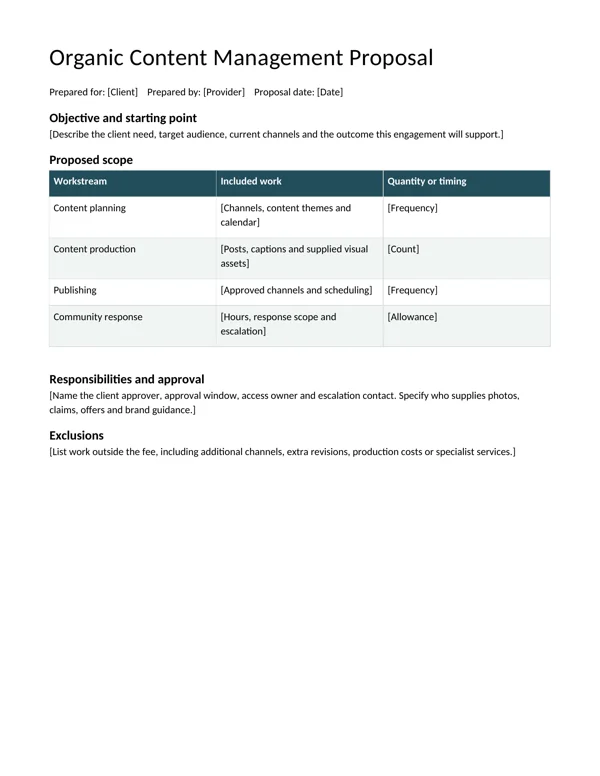
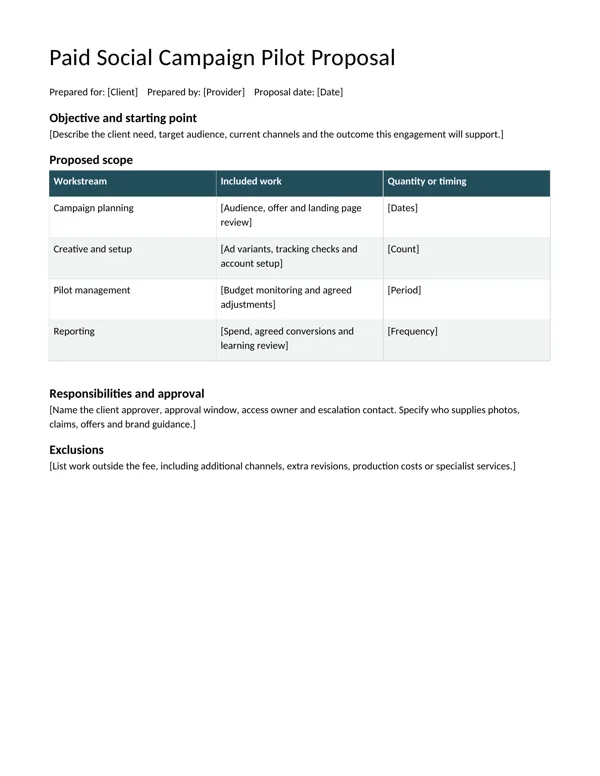
Organic content management usually concerns a continuing publishing process, while a paid campaign pilot has a defined test period and a separate media budget. These are different engagements even when the same provider delivers them. The organic template includes planning, content production, publishing and an agreed response allowance. The pilot template emphasizes campaign preparation, tracking checks, management and a review of the results. Remove work that is outside your actual offer instead of presenting every possible service as part of one standard package.
Describe deliverables in terms the client can compare
A promise to manage social media leaves too much open to interpretation. State the channels, number and type of outputs, review process and the period covered. Explain who supplies photographs, product information and approved claims. Distinguish creating a post from publishing it and from responding to comments afterward. If community management is included, define the hours, allowance and escalation process. A proposal becomes more useful when the client can see what will be delivered and what needs separate discussion.
Keep fees and media spend separate
The paid pilot template distinguishes the professional fee from the advertising budget. State who pays the platform, who controls the account and how changes to the budget are approved. Identify production costs or additional services that sit outside the main fee. For an ongoing organic arrangement, explain the monthly allowance and the process for additional work. The template does not supply a universal market rate. Use your actual costing and approved commercial terms, and make the currency and billing basis unambiguous.
Agree how results will be interpreted
Choose measures that relate to the client’s objective and identify their source and reporting period. Platform activity, website actions and business outcomes describe different things. A report should not imply that every change in sales came from the social work. Explain the available tracking and any limitations that affect interpretation. For a pilot, agree the questions the test will answer and the point at which the client decides what happens next. Avoid guaranteed results that the provider cannot control or substantiate.
Download the templates and view the previews
Organic Content Management Proposal
The preview shows the opening page. The download is an editable Word document; review every page after entering your own information. Keep an original copy of the download and save your project under a separate descriptive name.
Paid Social Campaign Pilot Proposal
The preview shows the opening page. The download is an editable Word document; review every page after entering your own information. Keep an original copy of the download and save your project under a separate descriptive name.
Details to check before using the template
- Client need and audience
-
Describe the business issue, the intended audience and the relevant starting point. Use information confirmed with the client rather than assumptions copied from another proposal. A clear objective helps both sides decide whether the suggested channels and deliverables are proportionate to the work they actually need.
- Channels and outputs
-
List the channels and the outputs included in the fee. Specify counts, formats and the period they cover. A set of short videos has different production requirements from a set of text posts. Keep the wording concrete enough for the client to compare the scope with another provider’s proposal.
- Approvals and access
-
Name the client approver, the provider contact and the process for giving access. Agree the approval window and how delayed feedback affects the schedule. Use appropriate account access arrangements rather than inserting passwords into the proposal. State who confirms factual claims, product details and any offer before it is published.
- Management boundaries
-
Explain the ongoing work included after content goes live. A publishing service does not automatically include continuous monitoring or customer support. If responses are part of the scope, define what the provider can answer and when an inquiry must be escalated to the client’s team.
- Fees and additional costs
-
Show the professional fee, billing basis and any separate cost categories. For paid work, distinguish the media budget from the service charge. Explain how additional production or a larger scope will be quoted and approved so a request for more content does not become an unrecorded change to the engagement.
- Reporting and next decision
-
State the reporting frequency, measures and review meeting where appropriate. Identify what the client will decide at the end of a pilot or review period. Keep the reporting promise connected to the data that will actually be available, and record any changes to the objective or measurement approach.
A practical example
A small business may need a monthly organic proposal covering a defined number of approved posts and a limited comment-response allowance. A campaign pilot may instead cover one offer, a fixed test period, agreed creative variants and a separate advertising budget. Use the matching template and confirm the scope before entering the fee. The two proposals should make the difference in work and responsibilities visible.
How to prepare the finished version
- Save a separate working copy. Open the Word download and save a copy with a name that identifies the trip or client project. Keep the original template available for future work. Read the complete document before filling the first section so the schedule, responsibilities and supporting notes remain consistent. The prompts are there to guide editing and should not be left in a copy that someone will rely on.
- Enter the confirmed information. Work from the actual brief, booking confirmations or agreed scope. Replace the bracketed prompts and remove fields that do not apply. Distinguish confirmed details from items awaiting approval. If another person supplies information, record who should verify it rather than turning an uncertain detail into a definite statement simply because the document has a space for it.
- Check longer entries and page breaks. Use realistic names, addresses and descriptions while reviewing the layout. Long text can wrap differently from a short prompt, particularly inside a table. Add rows or adjust spacing when needed and keep related information together. Do not shrink the whole document to make one crowded section fit. Inspect every page after the final wording is in place.
- Review the document with its owner. Ask the person responsible for the trip or engagement to check the details that affect other people. Confirm the dates, responsibilities, contact route and any outstanding action. The template organizes information but cannot establish whether an arrangement is actually confirmed. Make the review meaningful by asking about the content and the next step, not only whether the document looks tidy.
- Keep the editable and shared versions aligned. Retain the Word file and generate a fixed-layout copy only when the sharing process calls for one. Open that output and inspect it before distribution. When a material detail changes, update the source first and make a new approved version. Use a clear revision name or date so a colleague can distinguish the current document from an earlier copy.
A final project review
Review revision allowances before the proposal is sent. State how many rounds are included, what counts as a revision and what happens when the client changes the brief after approval. Keep this consistent with the production schedule and the fee. A request to change a caption is different from replacing an entire creative direction, and both parties benefit from knowing how that distinction will be handled. Ask the person managing delivery to review the proposed allowance so the sales document reflects the work the team can actually support. Record any agreed change in the revised proposal rather than leaving it only in an informal message.
What a social media proposal does
A social media proposal is the document a freelancer, agency or in-house team sends to explain how they will manage a brand’s social channels and what it will cost. It sits between the first conversation and a signed contract. A good proposal shows that you understood the client’s goals, explains what you will deliver each month, sets out how work will be approved and measured, and states fees and terms clearly enough that the client can say yes without a dozen follow-up questions.
These social media proposal templates cover the two most common types of engagement. The first is for organic management: planning, creating and publishing posts, and handling community engagement. The second is for a paid campaign pilot: a short, defined test of paid ads with a budget, targeting plan and success criteria. Both are editable Word documents, so you can add your branding and adjust each section to the client.
Organic management vs paid campaign pilot
Organic management proposal
Organic work is ongoing. The proposal focuses on which platforms you will manage, how many posts per week, what content types you will create, how quickly you will respond to comments and messages, and how you will report on reach, engagement and follower growth. Fees are usually a monthly retainer, often with a minimum term.
Paid campaign pilot proposal
A pilot is time-limited, often four to eight weeks. The proposal defines the objective, such as leads or sales, the platforms, the audience, the creative to be tested, the ad budget, your management fee and the metrics that will decide whether to continue. Clients appreciate pilots because they limit risk before committing to a longer contract.
Sections every social media proposal should include
Overview and goals
Summarize the client’s situation in their own words and state two or three goals, such as increasing website visits from social or building an engaged local audience.
Audit summary
Briefly note what is working and what is missing on current channels. Keep it constructive.
Scope of work
List platforms, deliverables, posting frequency, content types, community management hours and what is not included.
Content approach
Describe themes, tone of voice and how content will be planned, for example a monthly calendar shared for approval.
Approval process
Explain who approves content, how far in advance, and what happens if approval is late.
Reporting
State what you will report, how often and in what format.
Timeline
Outline onboarding, first content calendar, launch and review points.
Fees and payment terms
Retainer or project fee, ad spend handling, invoicing schedule, late payment terms and what triggers extra charges.
Terms and next steps
Contract length, notice period, ownership of content and accounts, and how to accept the proposal.
How to write a proposal step by step
- Run a discovery call. Ask about goals, audience, past results, budget and decision makers.
- Review current channels. Note posting frequency, engagement, brand consistency and response times.
- Choose the right template. Use the organic template for ongoing management and the pilot template for paid tests.
- Write the overview. Reflect the client’s priorities back to them in plain language.
- Define scope precisely. Specify numbers: posts per week, stories, reels, comment response windows.
- Set approval and reporting rules. Agree how content is signed off and how success is measured.
- Price the work. Base fees on hours and value, and separate your fee from ad spend.
- Proofread and brand. Add your logo, contact details and a professional email signature for the cover email.
- Send and follow up. Offer a short call to walk through the proposal.
When to send a proposal
Send a proposal after a discovery call when the client has asked for pricing, when responding to a request for quotes, when an existing client wants to add platforms or paid ads, or when you want to formalize a trial. Avoid sending detailed proposals before you understand goals and budget; generic proposals rarely win work.
Tips for winning proposals
- Lead with the client’s goals rather than a list of your services.
- Use numbers for scope so expectations are measurable.
- Offer two or three package options when budgets are uncertain.
- Separate ad spend from management fees to avoid confusion.
- Include one or two relevant examples of past work, with permission.
- Keep it concise; most clients skim before reading in detail.
- Set an expiry date on pricing.
Common mistakes
- Promising specific follower or sales numbers. Results depend on many factors; commit to activities and reporting instead.
- Unclear revisions. Without limits, edits can consume your margin.
- No account ownership terms. State that the client owns its accounts and ad accounts.
- Vague reporting. Define metrics and frequency.
- Forgetting response times. Community management expectations should be explicit.
Worked example: a local bakery
A bakery owner wants more weekday orders and better visibility on social media. After a discovery call, a freelancer sends two documents. The organic proposal covers Instagram and Facebook, with three feed posts and five stories per week, a monthly content calendar for approval by the 25th of each month, comment and message responses within one business day, and a monthly report on reach, engagement and website clicks. The retainer is billed monthly with a three-month minimum.
Alongside it, the freelancer offers a six-week paid pilot promoting weekday lunch boxes to people within a few kilometers, with a fixed ad budget paid directly by the bakery, a separate management fee, and a decision point based on cost per online order. The freelancer includes a short SWOT analysis of the bakery’s current presence and reports progress using a status report template. The bakery chooses the organic package and the pilot, signs, and the work begins the next month.
Pricing approaches
Social media work is commonly priced as a monthly retainer, a per-project fee, or an hourly rate. Retainers suit ongoing organic management because workload is predictable. Project fees suit audits, launch campaigns and pilots. Hourly rates suit ad hoc support. Whatever model you use, show what is included, what costs extra, and how ad spend is paid. Some freelancers show a simple comparison of packages using a product comparison layout so clients can see differences between tiers at a glance.
Presenting the proposal professionally
Presentation affects how seriously a proposal is taken. Use the client’s name throughout, add a clean cover page with your logo, keep fonts and colors consistent, and export to PDF before sending so formatting does not shift. Include a short summary of your business, much like a mini company profile, with your experience and contact details. Finally, make acceptance easy: provide a signature block, an online acceptance link or clear instructions to reply by email.
After the proposal is accepted
Turn the accepted proposal into a contract or statement of work, collect access to accounts using secure methods such as business manager roles rather than shared passwords, and schedule an onboarding call. Set up the content calendar and reporting dashboard before the first post goes live, and confirm the approval contact. A smooth start builds trust and makes renewals far more likely.
Tailoring proposals for different clients
A proposal for a local café should look different from one for a software company or a charity. Small local businesses often value simple language, visible community engagement and modest monthly fees. Business-to-business companies may care more about thought leadership, lead quality and integration with sales teams. Nonprofits often need to show impact to boards and funders, so reporting on reach and supporter actions matters. Adjust the goals, examples and metrics in each template to fit the client’s world, and remove sections that do not apply rather than leaving generic filler.
Social media proposal template FAQs
What is the difference between a proposal and a contract?
A proposal describes the plan and price. A contract is the legally binding agreement that follows. Many freelancers convert the accepted proposal into a contract.
Should ad spend be included in my fee?
It is clearer to keep ad spend separate and have the client pay platforms directly, with your management fee shown separately.
How long should a social media proposal be?
Long enough to cover goals, scope, approvals, reporting and fees. Many effective proposals are just a few pages.
Can I use the templates for an agency?
Yes. Add your agency branding, team roles and standard terms.
Should I guarantee results?
Avoid guarantees on followers or sales. Commit to deliverables, timelines and transparent reporting.
What if the client wants changes?
Revise the scope and price together and send an updated version with a new date.
Conclusion
A clear social media proposal helps clients understand exactly what they are buying and helps you start work with aligned expectations. Use the organic management template for ongoing work and the paid campaign pilot template for limited tests, define scope and approvals, and keep fees transparent. Download both Word templates above and browse more business documents in the category archive. A focused, honest proposal is often the difference between a polite maybe and a signed agreement, so take the time to tailor each one.
Related resources
For related planning and supporting information, explore Free Company Profile Templates and PDF Examples, Customer Information Sheet Templates and Examples, Memo Templates and Business Memorandum Example. Choose the resource that matches the next step and keep the information consistent with your current project.
Frequently asked questions
Which template covers paid advertising?
Use the paid social campaign pilot proposal. It separates the professional fee from media spend and includes campaign preparation, management and review prompts.
Are platform advertising costs included in the service fee?
The templates keep those categories separate. Replace the prompts with the actual agreed arrangement and identify who pays each cost.
Can I use the proposal as a signed agreement?
The files provide proposal structure and acceptance prompts. Add the actual terms and approval process appropriate to the engagement rather than assuming the template settles every commercial issue.