
These project outline templates help you describe the purpose, scope, deliverables and main steps of a project before detailed work begins. Download two original Excel worksheets: a project outline for the overall plan and a milestone-and-action sheet for sequencing the work. Each download has a matching preview and editable example entries.
A project outline gives the team and sponsor a shared starting point. It should explain what the project is intended to achieve, what work is included and how completion will be judged. It is useful for a small business improvement, an internal event or a team assignment, but it should be adapted to the approval process of the organization using it.
Write the outline in clear language before adding a long task list. A reader should be able to understand the proposed outcome without needing to reconstruct it from dozens of activities. Replace the sample help-desk project in the worksheets with your own purpose, owners, milestones and acceptance checks.
Download the two worksheets | Read the completion guide | Frequently asked questions
Download the two editable templates
Each button downloads an original XLSX workbook directly. Open it in compatible spreadsheet software, save a fresh copy and replace the example entries. The preview shows the supplied layout; sample people, dates and amounts are illustrations. Check formulas after extending calculation ranges.
Project Outline Worksheet
Use the outline to agree the objective, scope, deliverables, owners, risks and acceptance checks before detailed scheduling.
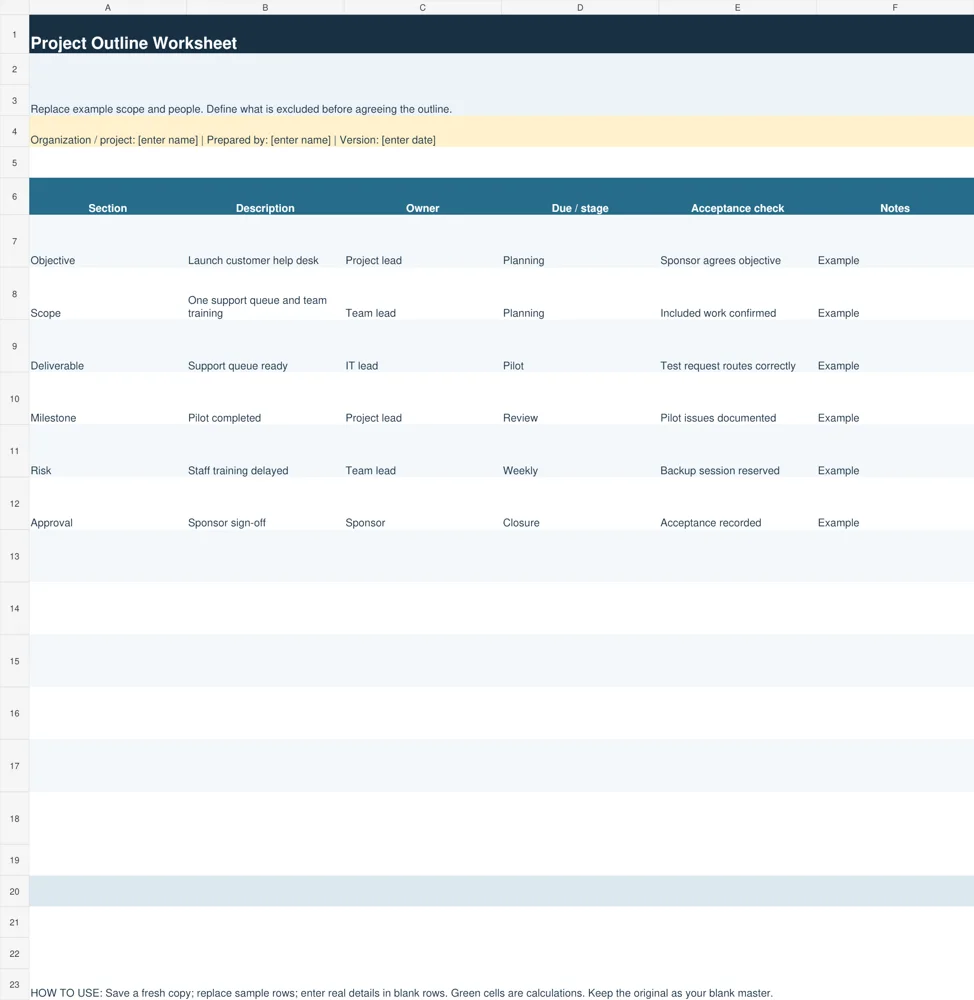
Download Project Outline Worksheet (XLSX)
Project Milestone and Action Plan
Use the milestone sheet to record sequence, owners, target dates, dependencies and manually maintained status.
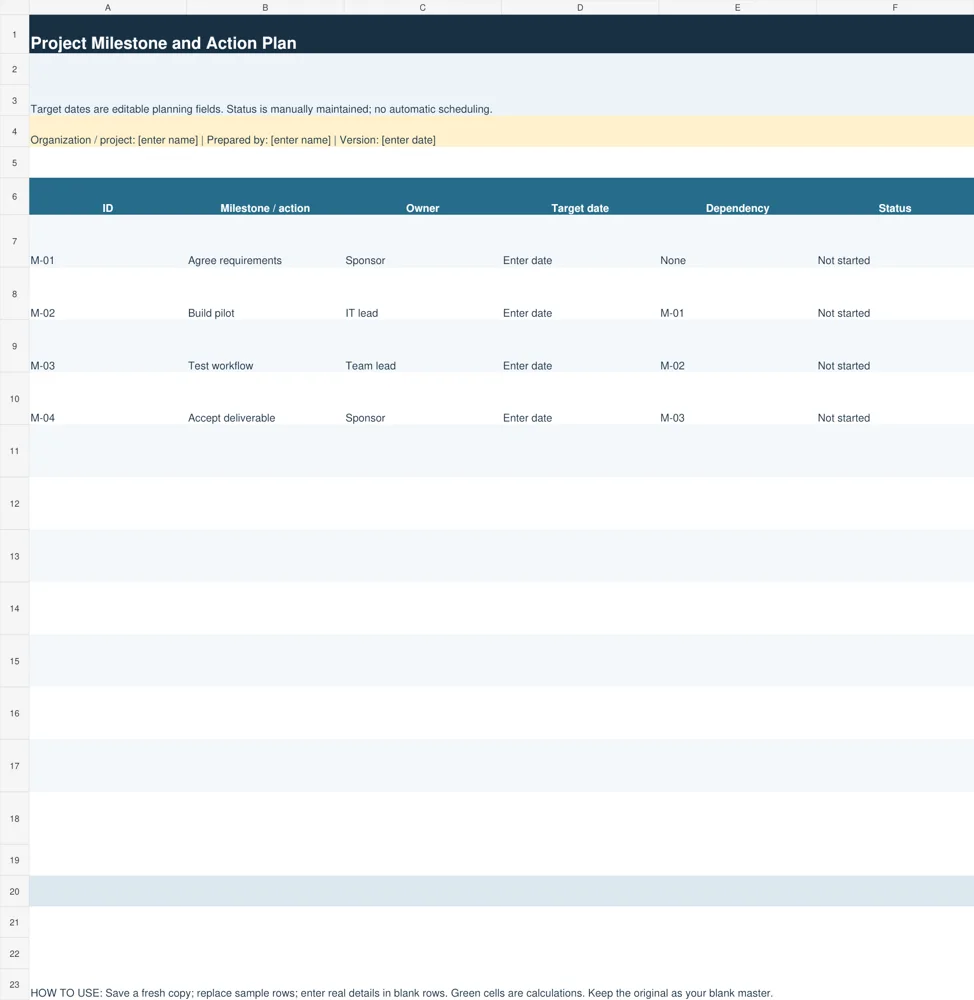
Download Project Milestone and Action Plan (XLSX)
What a project outline should explain
Start with the problem or opportunity and the intended outcome. For example, a team may want a shared help desk because requests currently arrive through several channels and are difficult to track. The outline should connect the proposed work to that problem. Naming a tool or an activity alone does not explain why the project exists.
Define scope by listing the work included and the work excluded. A help-desk pilot could include one support queue and staff training while excluding a full customer portal. Exclusions prevent assumptions from expanding the project after it has started. If the scope changes, record the change and obtain the approval required by your process.
Identify deliverables as outputs someone can review. A configured queue, a tested workflow and a completed training session are more specific than a statement such as improve service. For each deliverable, describe what would demonstrate acceptance. This lets the project owner and sponsor discuss completion before the team invests time in producing it.
Include the principal milestones, accountable owners, assumptions and significant risks. The outline does not need every operational detail, but it should expose dependencies that affect feasibility. If a pilot depends on access to test users, state that assumption and identify who will secure their participation.
Choose the outline or the milestone worksheet
The Project Outline Worksheet organizes the main planning sections in a table. It includes a description, owner, due date or stage, acceptance check and notes. Its example rows cover objective, scope, deliverable, milestone, risk and approval. Use it when a sponsor needs to review the overall proposal before detailed scheduling.
The Project Milestone and Action Plan focuses on sequence. It records an identifier, milestone or action, owner, target date, dependency and status. An identifier such as M-02 helps you refer to a task consistently even if the wording changes. The dependency column records which earlier milestone must be completed first.
The two workbooks are separate editable files. They do not automatically update one another or calculate a critical path. Use the outline to agree what matters, then transfer the approved milestones into the action sheet. For a complex project, dedicated scheduling software may be more suitable, while the outline can remain a concise explanation of purpose and scope.
Turn agreed actions into daily priorities with daily planner templates.
How to write a project outline step by step
First, meet the person requesting the work and clarify the expected result. Ask which problem must be solved, who will use the output and which constraints are fixed. Record the answers in the objective and scope sections. Where information is incomplete, state an assumption to confirm instead of presenting a guess as an agreed requirement.
Second, identify the deliverables and acceptance checks. A useful check describes observable evidence: a test request reaches the correct support queue, staff can follow the agreed process, or an authorized sponsor accepts the result. Avoid a vague check such as works well, which different people may interpret differently.
Third, map the main sequence and assign owners. Requirements usually need agreement before the team can build and test the result. A milestone should represent a meaningful checkpoint rather than every small activity. Give each milestone one accountable owner, even where several people contribute, so follow-up does not disappear between teams.
Fourth, review resources, risks and approvals. Identify the people, equipment or access needed at each stage. Discuss what could delay the work and what response is available. Then review the outline with the sponsor and relevant team members. Save the approved version separately so later edits can be compared with the original agreement.
Worked project outline: a help-desk pilot
The example project has an objective to launch a shared customer help desk. Its scope includes one support queue and a staff training session. The first deliverable is a configured queue. An acceptance check requires a test request to reach the appropriate person, with a visible record showing how it was handled.
The milestone sheet begins with agreeing requirements, followed by building the pilot, testing the workflow and accepting the deliverable. Each stage depends on the preceding one. The team should replace the example roles with actual names and enter realistic dates after confirming availability. The workbook does not infer dates from the dependency codes.
A possible risk is delayed staff training. The outline can record a backup session or another agreed response, but the response should be feasible and assigned to someone. If a delay affects the launch date, the team should discuss the change rather than leaving the original date in place and quietly treating the project as on schedule.
At acceptance, check the result against the agreed scope. A successful test of one queue does not mean a full customer portal has been delivered. Keeping the original acceptance checks visible prevents the team from confusing additional ambitions with the commitments made for the pilot. Future phases can have their own outline.
Clarify reporting responsibilities using organizational chart templates.
Project outline, proposal and detailed plan
A project outline summarizes the intended work and its boundaries. A proposal typically seeks approval or funding and may include alternatives, costs and a business case. A detailed project plan turns the approved direction into more specific tasks, dates, resources and controls. These documents can share information while serving different decisions.
For a small internal project, the outline and milestone sheet may provide enough structure to begin. Larger projects can require more detailed budgets, dependency schedules, procurement planning or specialist reviews. Use the requirements of the organization and the complexity of the work to determine the additional documents, rather than making every project use the same paperwork.
Keep the outline concise enough for a reader to review while still making important assumptions visible. If a detail belongs in another document, reference that document clearly and identify its current version. Do not create conflicting objectives in several places. The sponsor and team should know which record governs a changed requirement.
Review scope and keep the outline useful
Before sharing the outline, check whether the objective describes a result, the scope states boundaries and the deliverables have acceptance checks. Review the milestone sequence for missing prerequisites. Confirm that every owner understands the assignment and that dates are based on available capacity rather than a convenient-looking calendar.
During delivery, use the outline as a reference for decisions. When someone requests extra work, consider its effect on time, resources and acceptance. Record an approved change in a new version and communicate it to the people affected. Do not overwrite the original quietly, because that makes it difficult to explain why the project changed.
At closure, compare the delivered outputs with the agreed checks and note any outstanding work. Save the accepted version, supporting evidence and lessons that will help the next project. A reusable template becomes valuable when it preserves a clear planning process, while each completed outline remains specific to its own objective and constraints.
Communicate an approved project decision with our memo templates.
Additional original previews and source references
The existing previews below are retained as reference examples. Source links open third-party pages or PDF references and may have their own access or licensing conditions. They are separate from the two original editable downloads above. An unavailable source is identified instead of being presented as a working download.
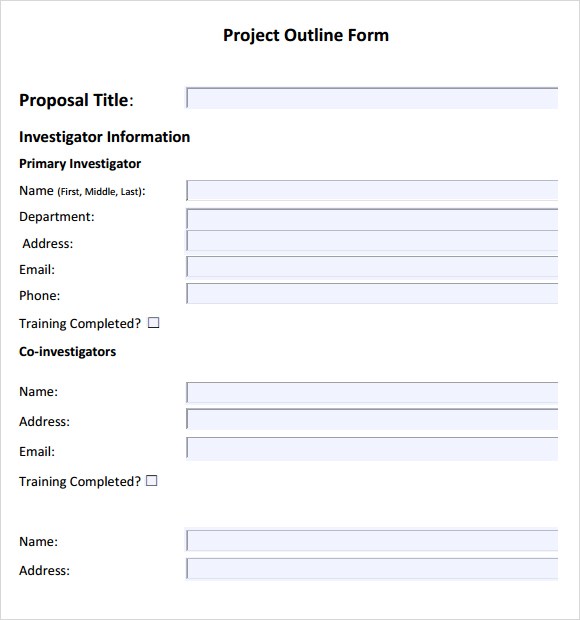
The original source for this preview could not be verified during the link check (the old address returned 404). Use the original editable downloads above for a direct file download.
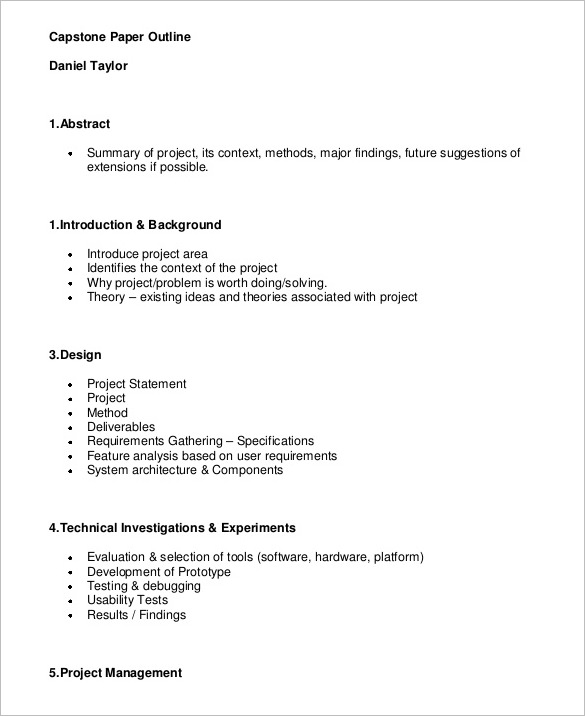
View original source 2 (external page). This is a source reference; inspect its format and access conditions there.
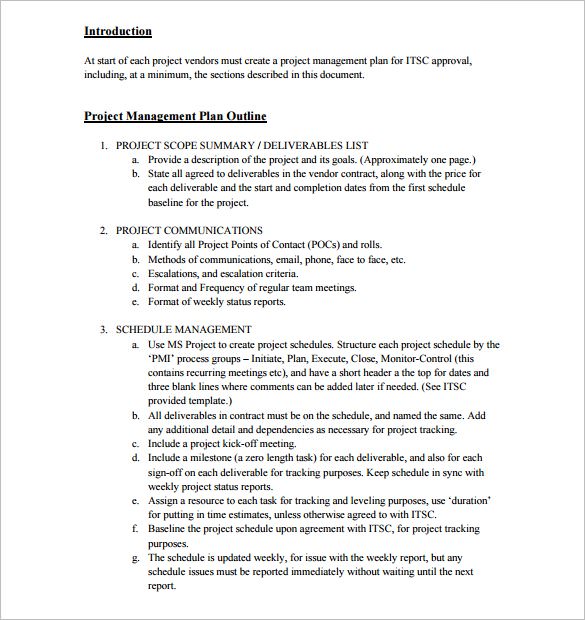
View original source 3 (PDF reference). This is a source reference; inspect its format and access conditions there.
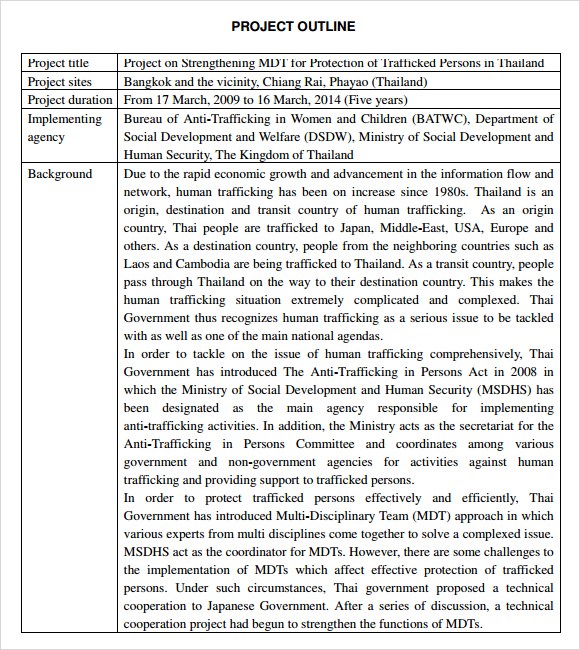
View original source 4 (PDF reference). This is a source reference; inspect its format and access conditions there.
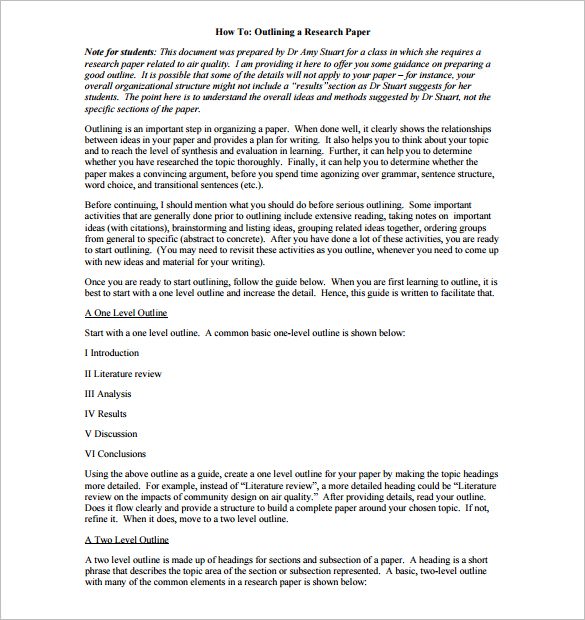
The original source for this preview could not be verified during the link check. Use the original editable downloads above for a direct file download.
Frequently asked questions
What is included in the free project outline downloads?
The page provides an editable XLSX project outline and a separate XLSX milestone-and-action plan. Both contain sample planning entries and blank rows. They are worksheets, not automated project-management applications.
How detailed should a project outline be?
Include enough detail to agree the objective, scope, deliverables, acceptance checks, main milestones, owners and important assumptions. Add detailed task schedules separately when the project requires them.
Does the milestone template calculate dates?
No. Target dates and dependency references are entered and maintained manually. Check the sequence and availability of people before committing to the schedule.
Can I use these templates for a student project?
Yes. Replace the business example with your assignment objective, required outputs and deadlines. Follow the structure or submission requirements supplied by your teacher or institution.
Where should approval be recorded?
The outline includes an approval row. Record the authorized person, approval date or stage, and the evidence required by your own process. A typed name by itself should not be assumed to satisfy every approval policy.
You must be logged in to post a comment.