
A military alphabet chart shows the words used to communicate letters clearly over radio or telephone. The commonly used NATO phonetic alphabet is also used outside the military. The printable charts below provide visual references; the text table makes the standard letter words easy to check.
View the templates and existing download links below.
Choosing the right format
Choose a chart with legible type and the full A–Z alphabet. Distinguish image previews from downloadable documents and external resources. When using a standardized NATO reference, check the spellings Alfa and Juliett rather than assuming ordinary English spellings.
Details to include
- All 26 letters with their corresponding phonetic words
- A clear layout at the intended print size
- The relevant standard or source, especially for training use
How to use the template
- Look up each letter in the reference.
- Practice spelling a short name slowly and consistently.
- Use the procedures taught by your organization for operational communication.
Worked example
To spell the name Sam, use Sierra, Alfa, Mike. The words represent letters; they do not translate the name.
NATO phonetic alphabet A–Z
| Letter | Phonetic word |
|---|---|
| A | Alfa |
| B | Bravo |
| C | Charlie |
| D | Delta |
| E | Echo |
| F | Foxtrot |
| G | Golf |
| H | Hotel |
| I | India |
| J | Juliett |
| K | Kilo |
| L | Lima |
| M | Mike |
| N | November |
| O | Oscar |
| P | Papa |
| Q | Quebec |
| R | Romeo |
| S | Sierra |
| T | Tango |
| U | Uniform |
| V | Victor |
| W | Whiskey |
| X | X-ray |
| Y | Yankee |
| Z | Zulu |
Reference: NATO’s phonetic alphabet. Historical charts may use different words; use the standard required by your organization.
Download and printing notes
The existing links include ZIP files. ZIP files are bundles; check their contents after downloading. Check editability, software compatibility and any formulas in the actual file before relying on them.
Why the military alphabet exists
Letters such as B, D, E, P, T and V sound almost identical over a crackly radio, a noisy phone line or a busy warehouse floor. The military alphabet, formally the NATO or ICAO phonetic alphabet, replaces each letter with a distinctive code word so that “B” becomes “Bravo” and “D” becomes “Delta”. The words were chosen and tested in the early 1950s so that speakers of English, French and Spanish could pronounce and recognize them reliably, and the alphabet came into international use in the mid-1950s.
Today the same 26 words are used by armed forces, air traffic control, shipping, police, emergency services, amateur radio operators and countless customer-service teams.
Who uses a military alphabet chart
- Pilots and air traffic controllers for call signs, taxiways and waypoints.
- Police, fire and ambulance dispatchers reading out vehicle registrations and addresses.
- Call-center and help-desk staff confirming names, booking codes and email addresses.
- Logistics and warehouse teams reading out tracking and part numbers.
- Students and cadets learning radio procedure.
- Anyone who regularly spells a difficult surname over the phone.
Numbers and special pronunciations
The alphabet is often paired with standard pronunciations for numbers. Aviation and maritime radio use forms such as “tree” for 3, “fife” for 5 and “niner” for 9 to avoid confusion, especially between “five” and “nine”. In everyday business calls, saying numbers normally but one digit at a time (“four, seven, zero”) is usually clear enough.
Two letter words have official spellings that look unusual: Alfa (not Alpha) and Juliett (with two t’s). These spellings help speakers of other languages pronounce them correctly.
How to learn the alphabet quickly
- Print a chart and keep it near your phone or desk.
- Learn five letters a day rather than all 26 at once.
- Practice spelling your own name, street and car registration aloud.
- Spell signs, number plates or product codes you see during the day.
- Test yourself by covering the code words and reading only the letters.
- After a week, try spelling full email addresses without looking.
Most people can recall the full alphabet within one to two weeks of short daily practice.
Ways to use the chart at work
Desk reference card
A small printed card next to the phone helps new call-center staff until the words become automatic.
Wall poster
A large chart suits training rooms, dispatch centers and classrooms.
Training handout
Combine the chart with practice exercises, such as spelling ten customer names.
Quick-reference in procedures
Add the alphabet to the back page of operating procedures or a staff contact list so it is always close by.
Tips for clear phonetic spelling
- Say “as in” only when talking to people unfamiliar with the alphabet: “B as in Bravo”.
- Pause briefly between words so the listener can write each letter.
- Group long codes into chunks of three or four characters.
- Ask the listener to read the code back to confirm.
- For email addresses, say “at” and “dot” clearly, and spell only the parts that are unusual.
Common mistakes
- Inventing your own words. “A for Apple, B for Boy” varies between speakers and can create confusion; stick to the standard words.
- Mixing alphabets. Switching between standard and improvised words in the same call confuses listeners.
- Speaking too fast. The words only help if each one is heard clearly.
- Wrong spelling in printed charts. Check that charts use Alfa and Juliett if you want the official forms.
- Forgetting the read-back. Confirmation is what actually prevents errors.
Example: confirming a booking reference by phone
A hotel receptionist needs to confirm booking code KX7-PD9. She says: “Kilo, X-ray, seven, dash, Papa, Delta, niner.” The guest reads it back: “Kilo, X-ray, seven, Papa, Delta, nine.” The receptionist confirms and adds the guest’s email: “That is j dot rahman at example dot com, Juliett, dot, Romeo, Alfa, Hotel, Mike, Alfa, November.” The read-back prevents a common mix-up between M and N and between D and B.
Military alphabet FAQs
Is the military alphabet the same as the NATO alphabet?
Yes. In everyday use, “military alphabet”, “NATO alphabet” and “ICAO phonetic alphabet” refer to the same set of 26 code words.
Why is it “Alfa” and not “Alpha”?
The “f” spelling helps speakers whose languages do not pronounce “ph” as an f sound.
Do I need to learn the number pronunciations?
For aviation and maritime radio, yes. For business calls, clear digit-by-digit reading is usually enough.
Is there a different alphabet for police?
Some police forces historically used their own word lists, but many now use the NATO alphabet. Check your organization’s procedures.
Can children learn the military alphabet?
Yes. It is a fun spelling game, and the printable charts work well in classrooms.
Templates to pair with the chart
If you are preparing training materials, pair the chart with an army memorandum template for drill instructions, an attendance sheet for training sessions and a sign-in sheet for visitors. More printable references are in the templates category.
Summary
The military alphabet replaces easily confused letters with clear, internationally recognized words. Keep a printed chart nearby, practice a few letters each day, use the standard words consistently and always confirm with a read-back.
Download Military Alphabets:
The format can be used as a learning aid or quick reference in classrooms, offices, communication environments, or personal study. Printing the chart makes it easy to keep the complete phonetic alphabet visible while practicing.


Military Phonetic Alphabet Chart
This military phonetic alphabet chart is designed as a reference for associating each English letter with its corresponding phonetic word. Such a chart makes it easier for beginners to learn the alphabet systematically.
It can be useful for students and anyone learning clear verbal spelling. Keeping the chart nearby allows users to check unfamiliar phonetic words quickly while building familiarity with the complete alphabet.

NATO Alphabet Chart
This NATO alphabet chart provides a straightforward reference for the standardized phonetic alphabet. The chart can help users recognize the words used to communicate letters clearly in radio, telephone, aviation, and other communication settings.
A printable version can be placed on a wall, desk, classroom board, or study area. It is especially useful for people who are learning the alphabet and need a visual reference during practice.

Printable Military Alphabet Chart
The chart can also support classroom instruction and independent learning. Users can print it at a suitable size and keep it near a workspace, communication equipment, or study area.

Military Alphabet Reference Chart
It can be used for study, training, or general reference. The simple A–Z structure makes it suitable for people who want to learn the phonetic alphabet gradually and use it confidently.

Military Alphabet Chart Sample
This military alphabet chart sample provides an example of how the phonetic alphabet can be presented in a visual reference format. It can help learners quickly connect each English letter with its corresponding phonetic word.
A sample chart can be useful for classrooms, personal study, or anyone creating a printed communication reference. The complete alphabet can be reviewed repeatedly until the phonetic terms become familiar.

NATO Military Phonetic Alphabet
The chart can be kept as a printable or digital reference for learning and communication practice. Its focus on the NATO alphabet also makes it relevant to searches for military phonetic alphabet resources.

Military Alphabet Chart Sample

NATO Military Phonetic Alphabet
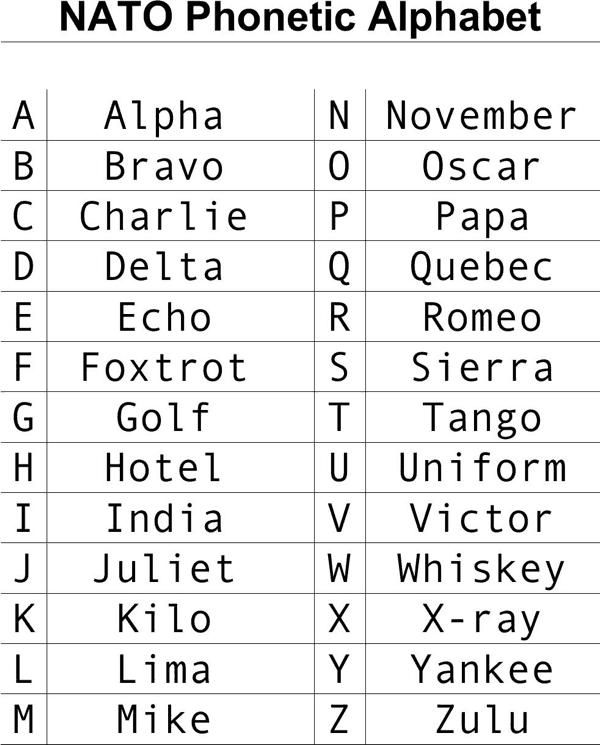
Military Alphabet Printable

Related templates
For related tasks, see Army Memorandum Templates and Formatting Guide.